AI in business management
Between overblown hype and unjustified fear, where does AI really help companies today? And why does the answer start with organized data, not with the tool?

Hardly a week passes without news about AI: a tool that writes, another that analyses, a third that promises to run the company on its own. Between overblown excitement and fear that it will replace everyone, business owners are left asking: what actually helps me today? This article is an attempt at a realistic answer about AI in business management, away from the big promises.
Where does it really help?
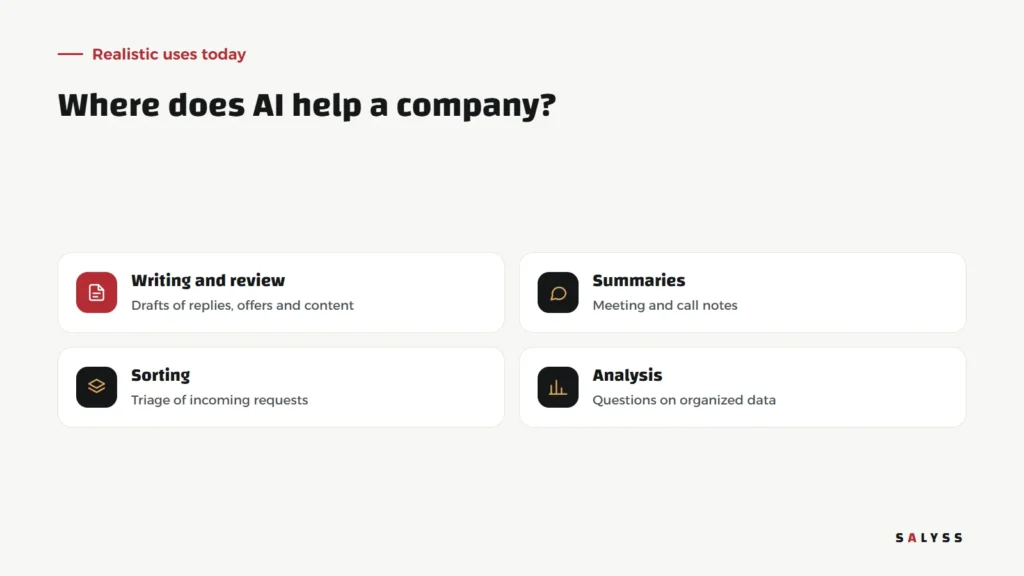
Writing and reviewing
Drafts of customer replies, proposals and marketing content. The tool gives you a fast start, and you add knowledge, tone and accuracy. The time saved here is real, as long as human review stays in place.
Summarizing
Meeting notes, long calls and documents. A good summary makes what was said in a meeting available to those who missed it, and turns a customer call into clear points in their file.
Sorting
Triaging incoming messages and requests by type or priority, so they reach the right person quickly. This is especially useful when messages arrive through several channels.
Analysis
Asking questions of organized data: which products are returned most? Which periods bring more orders? But this use depends on one thing: the data being organized in the first place.
A tool is only as good as what you give it
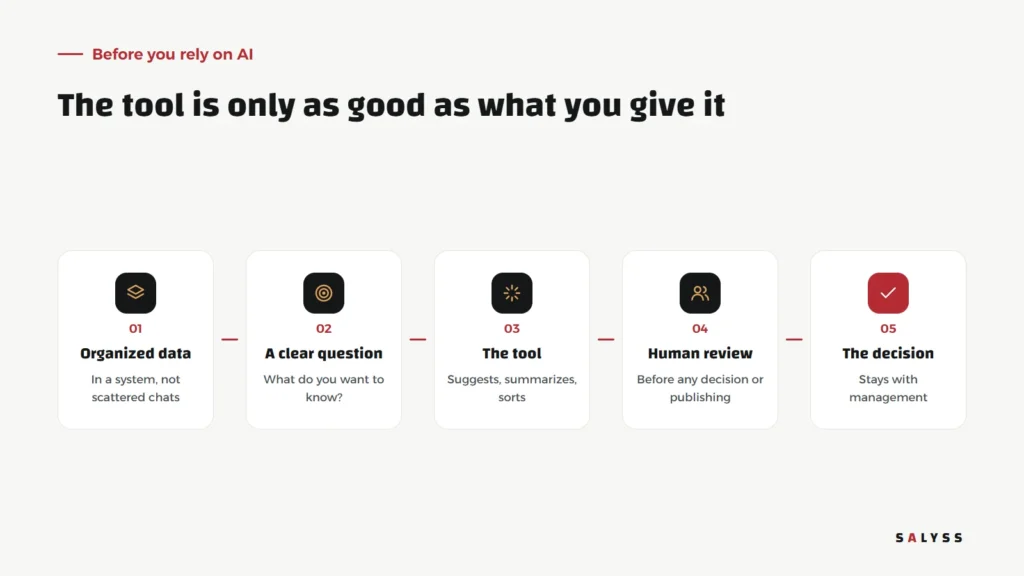
What gets overlooked most in AI conversations is that it depends on what you feed it. If your customer data is spread across WhatsApp chats, several spreadsheets and notebooks, no tool can analyse it. So the first step to benefiting from AI is often not choosing a tool, but organizing work in one system.
- Organized data: in a system, not in scattered messages.
- A clear question: what exactly do you want to know or get done?
- The tool: suggests, summarizes and sorts.
- Human review: before any decision, publication or customer reply.
- The decision: remains management’s responsibility.
Where should you be careful?
- Accuracy: tools can state wrong information with full confidence. Do not publish a figure or fact without checking it.
- Data: check each tool’s policy on what you enter, and do not enter sensitive customer data without reason and consent.
- Tone: a reply that sounds automated hurts your customer relationship more than it saves time.
- Full reliance: the tool helps with a decision; it does not make it.
A simple policy before you start
Before the team uses any tool, write one page answering three questions: which tasks do we use AI for? What data must never go into it? Who reviews the output before it leaves the company? That page protects the company from embarrassing mistakes and gives the team confidence to use the tool openly, instead of everyone using it their own way in private. Review it every few months, because the tools and their terms change quickly.
How we use it at SALYSS
We use AI tools for writing, coding and review, and everything they produce is reviewed by the team before it reaches a client or gets published. In SALYSS products we focus first on the foundation any smart use needs: organized data in one system, clear permissions, and a log of every action. We also make sure AI assistants can understand our clients’ websites through structured data, as we explained in our article on search visibility.
Where to start
Pick one repetitive task that eats your team’s time, such as drafting replies or summarizing calls. Try it for a few weeks, reviewing every result, then decide whether it deserves to grow. And if your data itself is not organized yet, start there. Book a free consultation to see together where your company should begin.
Frequently asked questions
Will AI replace employees?
In most companies today, AI helps as an assistant that speeds up work like writing, summarizing and sorting, while review, decisions and customer relationships stay with people.
Where should a company start with AI?
With one clear repetitive task, such as summarizing calls or drafting replies, and with organized data in a system rather than scattered messages.
Is it safe to enter customer data into AI tools?
Be careful. Check each tool’s data policy, decide what may be entered, and do not enter sensitive data without clear consent and a necessary reason.