Competitor analysis: what to watch and why
Watching competitors does not mean copying them. A structured analysis shows where they lead, where they fall short, and which opportunity nobody in your market has taken yet.

Many companies treat competitors in one of two ways: they ignore them completely, or they watch them anxiously and copy every move. Both are costly. Ignoring them means discovering late that customers found a better alternative; copying keeps you a step behind. A structured competitor analysis is different. It is calm, regular work that answers one question: what should we do differently?
Who are your competitors, really?
Start from the customer, not the market. A real competitor is the company a customer compares you with before deciding. It may be a smaller firm with faster service, or an alternative that looks nothing like you; a company selling a sales management system also competes with the spreadsheets the customer uses today. Ask your sales team which names customers mention on calls, and ask customers who chose a competitor why. You will get a short list more accurate than any general research.
What to watch
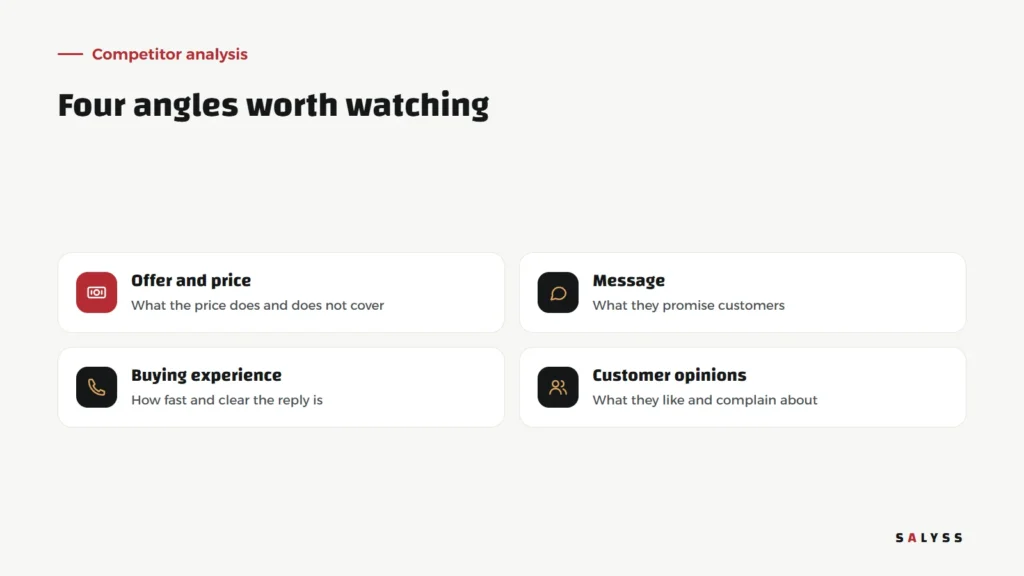
Offer and price
What exactly do they offer, and how is it priced? Packages or a single product? What does the price include, and what is paid separately? Do not stop at the published price; ask about terms and extras, because the real comparison is the full cost to the customer.
Message
What do they promise customers? Read their website, ads and pages: which words do they repeat, and which problem do they say they solve? The message reveals who they target, and sometimes a gap nobody talks about.
Customer experience
Try it yourself: call, ask for a price, request a proposal. How long did the reply take? Was it clear? Did anyone follow up? The buying experience tells you what the website does not, and it is often the biggest opportunity to stand out.
Customer opinions
Reviews on Google and in comments show what customers like and what they complain about. A recurring complaint about a competitor is a promise you can make and keep.
The steps of the analysis
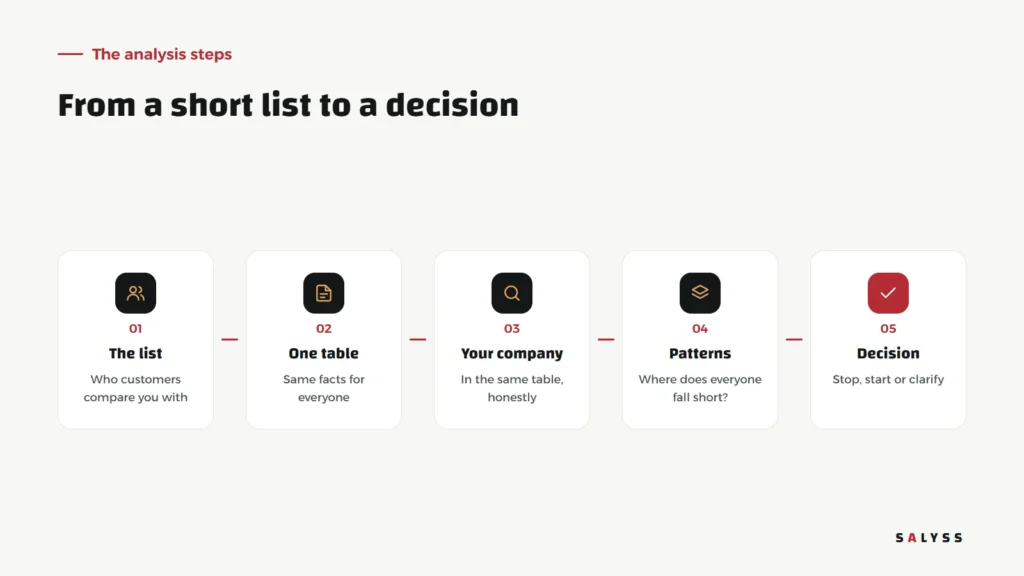
Choose three to five real competitors. Gather the same information on each in one table: offer, price, message, channels, buying experience and what customers say. Then put your own company in the same table, honestly. Look for patterns: where is everyone similar, and where does everyone fall short? Finally, extract one or two decisions: something to stop, something to start, or something to say more clearly.
What not to do
- Copying literally: what works for a competitor may depend on conditions you do not have.
- Price wars: cutting prices in reply to every move exhausts both sides, and customers learn to wait.
- A one-off analysis: markets change, and an old analysis can mislead you.
- Unethical methods: posing as a customer to obtain confidential information, or smearing a competitor, harms you before it harms them.
- Analysis without a decision: a beautiful table that changes nothing in your work is worthless.
Where opportunities usually are
From our work with real estate and retail companies, the biggest opportunities are rarely in the product itself, but in the service around it: how fast enquiries are answered, how clear the offer is, follow-up after the sale, ease of payment. In many markets products look alike, while what happens after a customer presses “contact us” differs hugely. If competitors reply slowly, an organized fast reply is a measurable advantage. If they do not follow up after the sale, read about after-sales service.
Watch their digital presence too
Much of today’s competition happens before a customer contacts anyone. Search for your service the way your customer does: who shows up in the results? Who has a fast website that answers questions clearly? Who publishes useful content that builds trust before the sale? What do each competitor’s Google Maps profile and reviews look like? You do not need complex tools; half an hour of searching through a customer’s eyes reveals a lot. If competitors share generic messages and weak websites, that is your chance to stand out with clear content and fast pages, as we explain in our article on content marketing for businesses.
Make analysis part of daily work
Your best source of competitor information is your own team. When salespeople record in each lead’s file which competitor the customer is comparing, and the reason for any lost deal, a real picture of the market builds up with no extra effort. Within a few months you will know who you lose to most, and why. That makes analysis part of the work rather than a separate project. Read about lead follow-up.
Where to start
This week, ask each salesperson for two competitor names they have heard from customers, and one reason customers chose them. Then go through the buying experience yourself at two competitors. You will come away with enough notes for a first decision. If you want your team to record the competitor and loss reason in every customer file, explore SALYSS Realty (page in Arabic), or book a free consultation.
Frequently asked questions
Who are my real competitors?
The companies a customer compares you with before deciding, not necessarily the biggest names. Ask your customers: who else did you consider?
How often should I update the analysis?
A short review every quarter is enough for most companies, with a quick look at any big change such as a new competitor or a different offer.
Should I copy what works for a competitor?
Take the lesson, not the form. Understand why it worked, then ask how you can offer something better or different to your customers.