Pricing products and services without losing money
A low price does not guarantee sales, and a high one does not guarantee profit. How do you build a price that covers your real cost and reflects the value you deliver?

Business owners often set prices quickly: look at a competitor’s price and land near it, or add a percentage to the product cost and stop there. Then they are surprised that sales look good while the bank account does not. The reason is rarely too few sales; it is a price not based on the real cost, or one that does not reflect the value delivered. Pricing deserves hours of calculation, because it affects every sale that follows.
The building blocks of a price
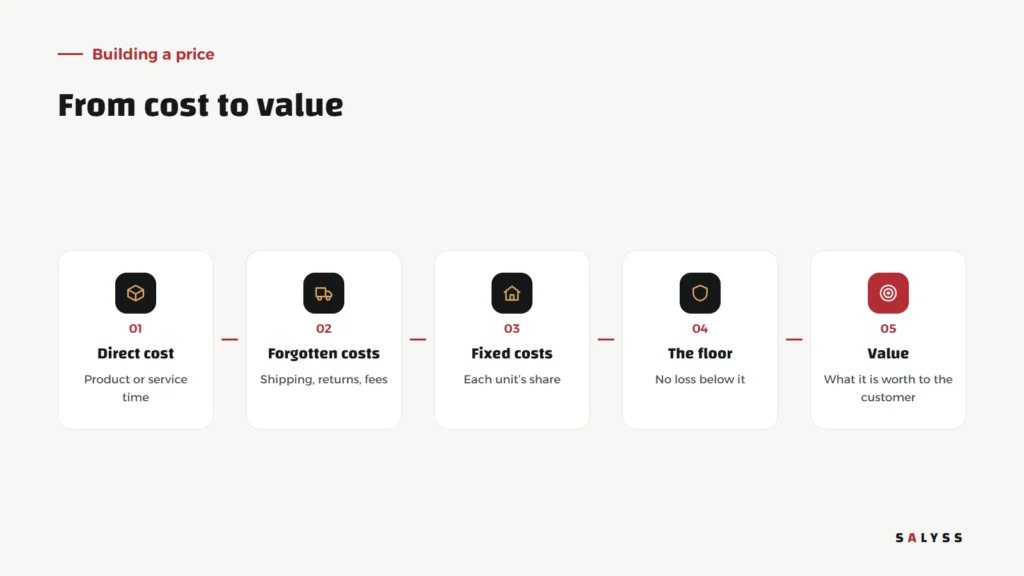
Direct cost
What you spend on each unit sold: the product or its materials, packaging, and shipping if you cover it. In services, direct cost is the time of whoever delivers the service, counted in actual hours, not expected ones.
The costs people forget
This is where most profit disappears. Payment fees, returns and their shipping, orders refused at the door under cash on delivery, and customer service time before and after the sale. All are real costs paid on every order, even if they never appear on a supplier invoice.
A share of fixed costs
Rent, salaries, systems and marketing are not tied to one unit, but every unit sold must carry part of them. Skip that share and you can sell a lot and still lose at month-end.
Value to the customer
Once you know the lowest price that covers your cost, ask: what is my offer worth to the customer? Value comes not only from the product but from speed, guarantees, ease of dealing and trust. It is what lets you price above the minimum without losing the customer.
Cost-only pricing, or value-based pricing
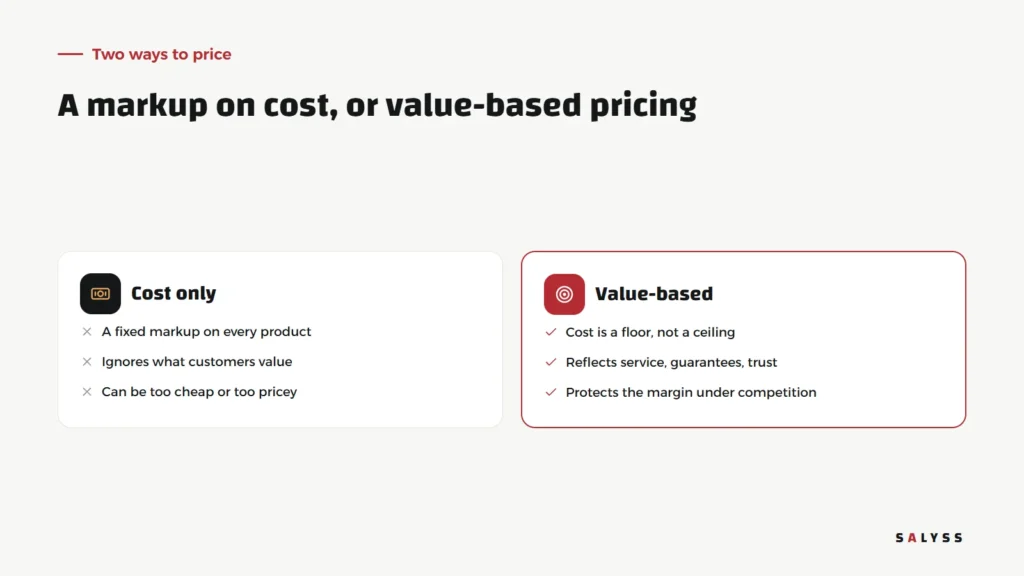
Adding a percentage to cost is easy and comfortable, but it ignores the customer entirely. It may make you too cheap on a product customers value, or too expensive on one they see as ordinary. Value-based pricing starts from cost as the floor, then asks what the customer pays for the benefit they get. It requires understanding the customer, but it protects the margin and lets a company compete on what it offers rather than on what it cuts.
Pricing mistakes we see often
- Copying a competitor’s price: their costs are not yours, and they may be losing money too without you knowing.
- Discounts as the answer to everything: frequent discounts teach customers to wait for them and quietly eat the margin.
- One price for everyone: sometimes different packages for different needs work better than cutting the price for all.
- Freezing prices for years: costs change, and an unreviewed price slowly loses its value.
- Hidden extra charges: fees that appear at the last step cost more trust than they earn in money.
Packages and options
Instead of one price, consider clear options: a basic one for those who need the minimum, and a complete one for those who want fuller service. Packages make customers choose between your offers rather than between you and a competitor, and let those who value more service pay for it. The difference between options must be clear, and the list should never become so complex it confuses people.
In real estate: price and payment plan together
In property development, buyers do not compare price alone but the whole payment plan: the down payment, the number of instalments and the value of each. Pricing becomes tied to collection; a long payment plan attracts more buyers but needs organized instalment follow-up so it does not turn into overdue debt. We cover that in our article on collecting property instalments.
In online stores: price the whole order
In an online store, profit is counted per order, not per product: the product price, minus its cost, minus shipping, minus payment or collection fees, minus a share of returns. An order refused at the door costs shipping both ways with no sale. All of this must go into the price, as we discussed in our article on online store launch mistakes.
When to raise prices, and how
Many owners fear raising prices in case they lose customers, so they delay until the margin is very thin, then raise prices sharply in one go and shock customers. It is better to review regularly and make increases understandable and justified. Tell existing customers in advance, explain the reason honestly if costs have risen, and consider a transition period for long-standing customers. Above all, know before the increase what customers value in you. If they choose you for speed, service or trust, a reasonable increase will rarely drive them away; if price is their only reason, that is a sign your value needs to be built and explained more clearly.
Where to start
Pick your five best-selling products or services and calculate the full real cost of each, including shipping, returns, fees and a share of fixed costs. Compare the result with today’s price. If a product’s margin is thinner than you thought, that is where the review begins. If your cost figures are scattered across separate spreadsheets, explore SALYSS Commerce (page in Arabic), which brings orders, shipping and collection into one place, or book a free consultation.
Frequently asked questions
Should I price below competitors to attract customers?
Not necessarily. A lower price attracts customers who only want the cheapest, and leaves a margin that cannot absorb any mistake. Compete on value and service before price.
Which costs are usually forgotten in pricing?
Shipping, returns, payment fees, customer service time, and fixed costs such as rent, salaries and systems.
How often should prices be reviewed?
Whenever costs change noticeably, plus a regular review even when nothing obvious has changed, because small costs pile up quietly.