A marketing plan for your company, step by step
A marketing plan is not a file for a meeting, but clear answers to simple questions: who do you sell to, what do you say, where, and how do you know it works?

Many companies start marketing with a tool: a Facebook page, then an ad, then a campaign because a competitor ran one. Months later nobody can answer a simple question: what actually brought the customers? A marketing plan reverses that order. It starts with the customer and the message, then picks the tools that serve them. It does not need a long document or a big team, just honest answers to a few questions, written on two pages and reviewed every month.
The steps of a marketing plan
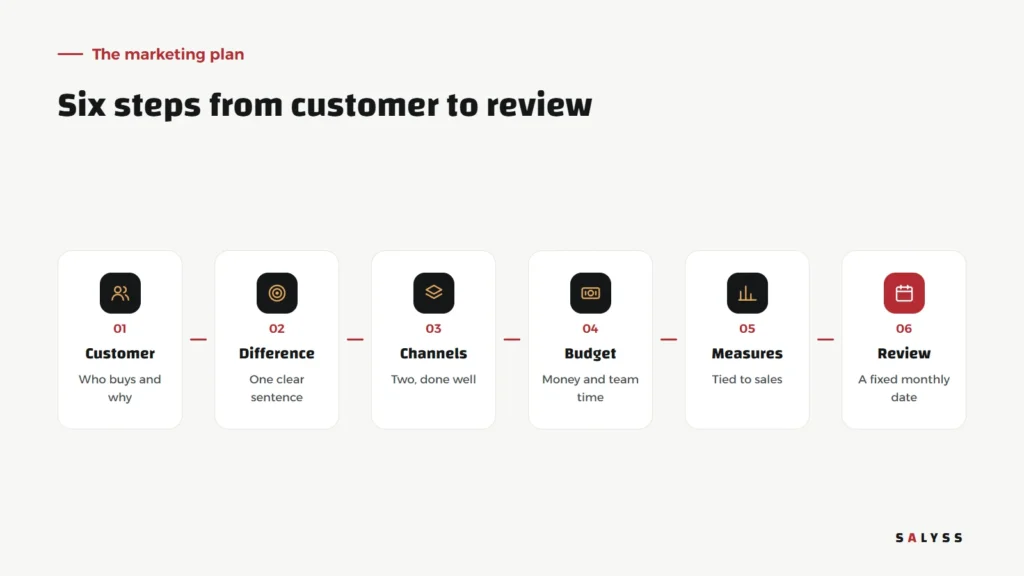
Understand your customer before you speak
Who actually buys from you? Not “everyone”, but a specific person: what they do, what problem they are trying to solve, what makes them hesitate, and where they look for answers. The best source is your sales team and customer records, not guesses in a meeting. Ask the salespeople: which questions come up in every first call? Why do some customers say no? Those questions are the raw material of your message.
State what sets you apart in one sentence
Why does a customer choose you over others? Write it in a sentence someone outside your industry understands. If you need a paragraph to explain the difference, it is not clear yet. And do not write what you would like to be, but what current customers say about you when they recommend you.
Pick a few channels
A good channel is one where your customer is, and where you can keep up quality. A company selling to other businesses may find clients through useful content, search and direct relationships; a clothing store may find them on Instagram and through ads. Two channels done well beat a weak presence in five.
Set a budget and time
A budget is not only ad money but team time too: who writes, who designs, who answers enquiries. A plan with no time set aside to run it stays on paper.
Choose measures tied to sales
Followers and views are supporting signals, but the real question is: how many serious leads came from each channel, and how many became contracts? That requires recording each lead’s source from first contact, or you will never know which channel deserves to continue.
Review every month
A short monthly meeting: what worked, what did not, what changes next month? A plan that is never reviewed becomes a habit, and marketing habits carry on long after they stop bringing customers.
How do you choose channels?
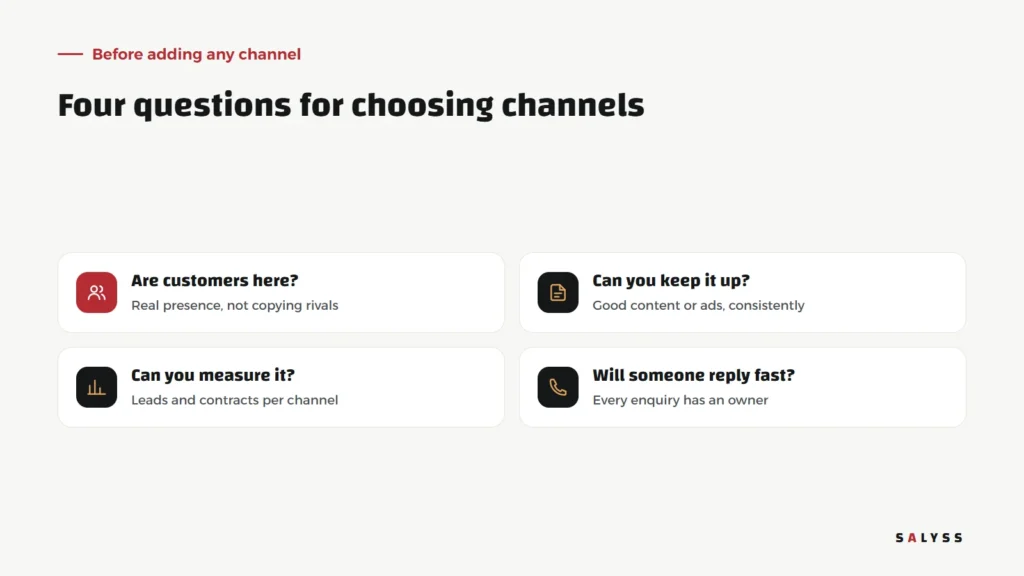
Before adding any channel, ask: are my customers really here? Can I produce good content or ads for it consistently? Can I measure what it brings? Do I have someone to answer its enquiries quickly? The last question is often forgotten, yet it decides the result. A successful ad that brings enquiries nobody answers for hours is a double loss: money spent, and a customer with a bad first impression.
Common marketing plan mistakes
- Running ads before the basics are ready: an ad leading to a slow site or a page that does not answer the ad’s question wastes the budget.
- A generic message: “high quality, fair prices” is what everyone says, so it sets nobody apart.
- Measuring what is easy to measure: likes are easy to count, but sales pay the salaries.
- Marketing cut off from sales: marketing brings leads, then never learns what happened to them.
- Changing everything every two weeks: some channels need time before results show, especially content and search.
Connect the plan to what happens after the enquiry
The most important lesson from working with real estate and retail companies is that a marketing plan does not end when an enquiry arrives. A lead recorded with its source, assigned to a salesperson and given a dated next step is what makes marketing measurable. When sales and marketing share one system, management can see which campaign brought customers who actually signed, not people who asked the price and vanished. That turns the decision to grow or stop a channel into one based on figures. Read more about lead follow-up and sales KPIs.
A two-page plan template
- Customer: who they are, their problem, where they look.
- Message: the one-sentence difference and three supporting points.
- Channels: two main channels, each with an owner.
- Budget: money and time for each channel.
- Measures: serious leads and contracts from each channel.
- Review: a fixed date every month.
Where to start
Sit with your sales team for one hour and write down together: your last ten customers who signed, how they reached you, and why they chose you. The answers hold the first version of your plan: customer, message and channel. Then prepare a clear page for visitors to land on, as we explain in our landing page guide. Explore SALYSS Realty (page in Arabic) to link each lead’s source to its outcome, or book a free consultation to review your plan together.
Frequently asked questions
Does a small company need a written marketing plan?
Yes, but a short one. One or two pages covering the customer, message, channels, budget and measures beat having no plan, and beat a long document nobody reads.
How many channels should I start with?
One or two where you know your customers are, and where you can keep up quality. Expansion comes after you understand what works.
How do I know the plan is working?
With measures tied to sales, such as the number of serious leads from each channel and how many became contracts, not views alone.