Project management from idea to delivery
Projects start with enthusiasm, then slip, swell, and nobody knows where they stand. How do you run a project with clear phases and a board everyone can see, whether it is construction or internal?

Whether your project is a residential building, a new website launch or moving the company onto a management system, the problems look alike: the delivery date slips, cost exceeds the plan, and each party sees only part of the picture. Project management is not software you buy but a way of working: clear phases, named owners, regular follow-up, and a board where everyone sees the same truth.
Project phases
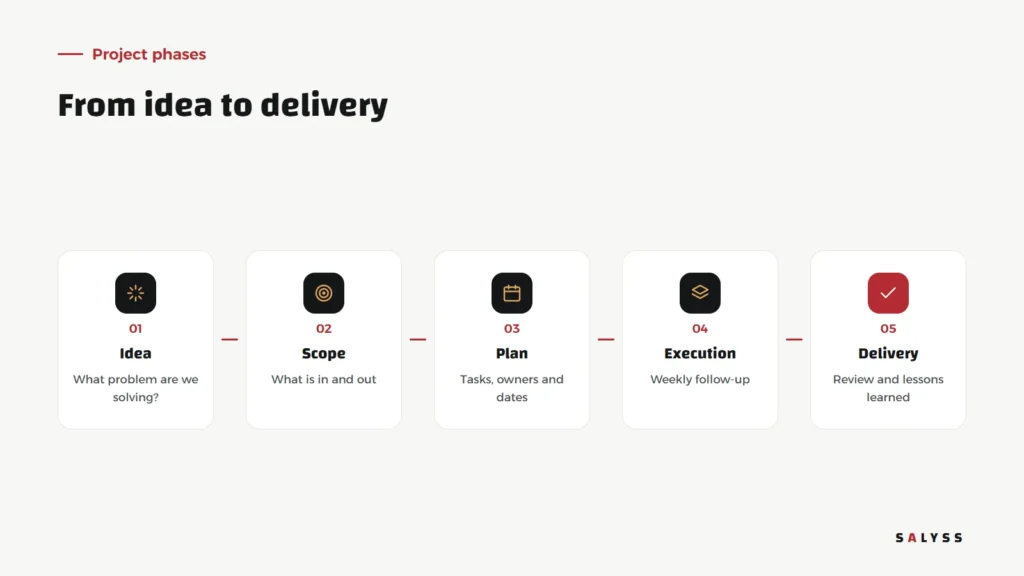
Idea: what problem are we solving?
Before any plan, write two lines: why this project, and what result will count as success? Those two lines bring you back on track whenever requests multiply later.
Scope: what is in and what is out
The most important project document is a list of what is included and what is not. Most delays come from a series of small additions, each seemingly simple, that together change the whole project. Additions are not forbidden, but their effect on time and cost must be reviewed before they are accepted.
Plan: tasks, owners and dates
Break the project into tasks small enough that the owner knows what to do this week. Each task gets a person’s name and a date, and you note what waits on something else to start.
Execution: weekly follow-up
A short meeting every week: what got done, what is late, what is blocking us? We wrote about running these in effective meetings.
Delivery: review and lessons learned
Delivery is not just the end of the project but a chance to record what the team learned: what worked, and what will we do differently next time?
The project board
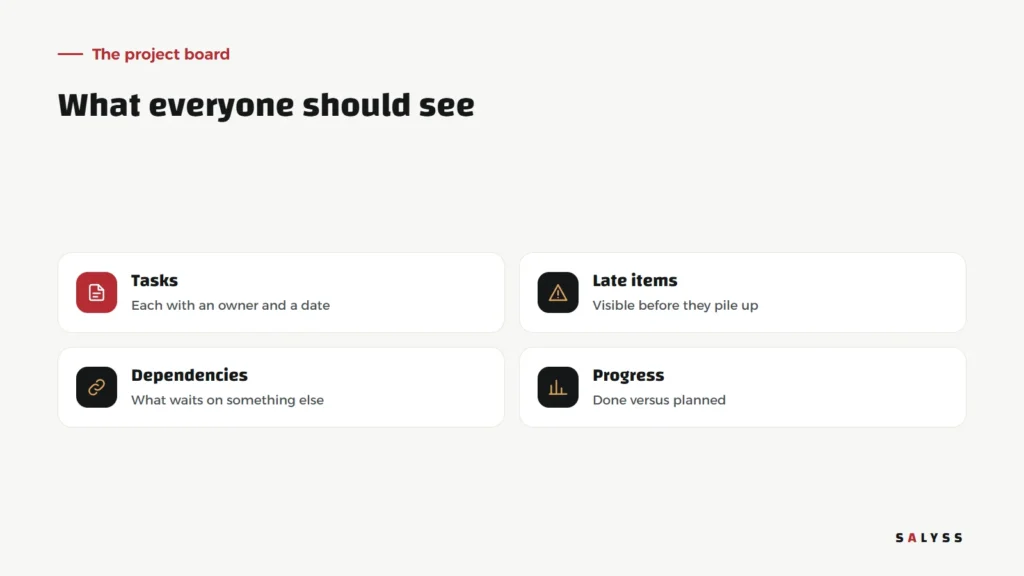
When project status lives only in the manager’s head or in scattered messages, every progress question becomes a meeting. A good board shows four things: tasks with owners and dates, clearly marked late items, dependencies between tasks, and progress against plan. It should update from the work itself, not need a separate update everyone forgets.
From our construction projects
Construction projects make the link between execution and money clear. Inside SALYSS Business Park at a real estate developer, we built work and claims tracking where the site engineer records items in detail, someone else approves them, and the project manager sees what has been paid on each project and what awaits review, with alerts for late claims. We explain it in tracking construction progress claims. The general lesson applies to any project: when everyone sees the same data, disputes shrink and the discussion turns to solutions.
Common project management mistakes
- Starting without written scope: each party imagines a different project.
- Optimistic dates: set by what we wish, not what the work needs.
- Shared ownership: a task owned by everyone is owned by no one.
- Hiding delays: a delay announced early can be handled; a hidden one surfaces at the worst moment.
- Delivering everything at the end: instead of usable parts in stages.
Most of these mistakes need no complex tools to avoid, just simple habits kept from day one: written scope, dates the doers help set, one owner per task, a culture where delays can be raised without fear, and an honest review at the end of each phase.
Keeping stakeholders informed
Every project has parties waiting for news: management, the client, contractors or suppliers, and sometimes other teams in the company. Much of the tension in projects comes not from delay itself but from people learning about it late. So decide from the start who needs to know what, and how often: a short weekly report for management, an update at the end of each phase for the client, and an immediate alert for any change that affects date or cost. When decision-makers can see the board themselves, fewer questions and reports are needed, and communication is about decisions rather than gathering information.
Internal projects need managing too
Many companies manage client projects carefully and leave their own internal projects without a plan: moving data to a new system, launching a website, reorganizing a department. These need the same phases, one owner and a real date. In choosing business software we discussed why delivering in stages reduces risk.
Where to start
Pick your most important project now and write on one page: the goal, the scope with what is in and out, and the task list with owners and dates. Then set a fixed weekly follow-up slot. If your projects are construction or real estate, explore SALYSS Realty (page in Arabic), or book a free consultation to discuss a tracking board that fits your projects.
Frequently asked questions
What is the most common reason projects run late?
Unclear scope at the start, followed by additions without reviewing their effect on time and cost. Stating what is in and out of the project prevents much of the delay.
Do I need dedicated project management software?
For small projects a simple task board may be enough. With several projects and teams, a system that links tasks to owners, dates and cost becomes more useful.
How often should project progress be reviewed?
A short weekly follow-up suits most projects, with a deeper review at the end of each phase.