Effective meetings: clearer decisions
A meeting ends without a decision, then another meeting to discuss what was left open. How do you make business meetings shorter and more useful, and make sure agreements turn into action?
Add up the hours your management team spends in meetings each week, then ask how many decisions came out of them, and the answer may surprise you. Meetings start late, the discussion wanders, and they end with “let’s continue next time.” The problem is not meetings themselves, which every team needs, but how they are run. Effective meetings have a clear shape before, during and after.
Before sending the invite
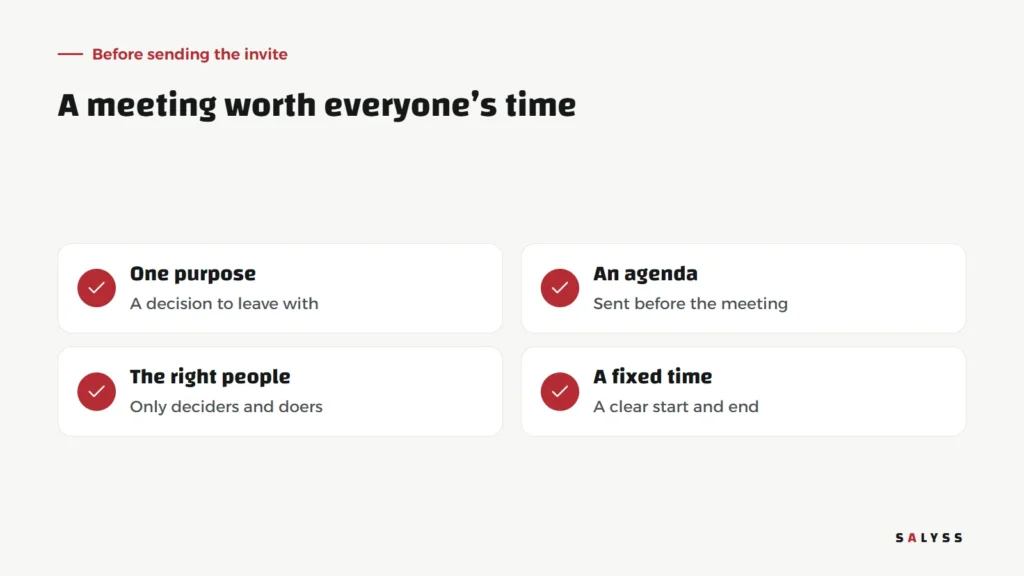
What is the purpose?
A meeting without a defined purpose becomes general conversation. Write it in the invite itself: what decision do we want to leave with? If there is none, you may not need a meeting; a written update may do.
An agenda in advance
A few items, ordered by importance, sent early enough. Attendees can prepare, and the meeting is not the first time anyone thinks about the subject.
Who needs to attend?
Whoever decides, whoever will carry it out, and whoever holds essential information. People who only need the outcome can read the notes.
A fixed time
A stated start and end, kept out of respect for everyone’s time. A meeting people know will end on time is more focused.
During the meeting
- Start with the decisions needed: not long introductions or a recap of what everyone knows.
- Stick to the agenda: an important side topic is parked for another meeting instead of consuming this one.
- Data before opinions: when figures are on one dashboard, no time is lost arguing whether they are right. See a KPI dashboard for managers.
- Give everyone a turn: the loudest voice is not always the best idea.
- Summarize at the end: read the decisions aloud so everyone leaves with the same understanding.
What happens after matters most
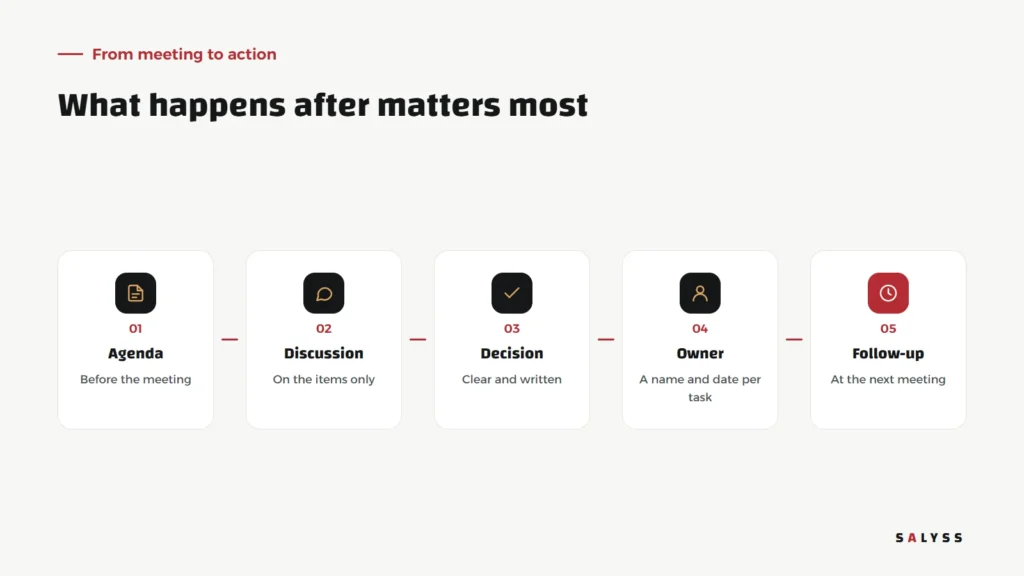
The biggest waste in meetings is not the time they take but decisions made and never carried out. Every meeting should end with short notes holding just three things: what was decided, who owns each task, and when it is due. The notes go out right after the meeting, not days later.
Better still, tasks go into the system the team works on, appearing in each owner’s task list with a reminder as the date approaches. Follow-up then depends on no one’s memory, and the next meeting starts with a quick check: what got done from what we agreed?
Recurring meetings
A weekly sales meeting or a monthly management meeting needs a fixed template: the key figures, then problems needing a decision, then new tasks. A fixed template makes preparation easier and the meeting shorter over time. Review recurring meetings now and then: is this one still necessary? Could it be shorter or less frequent?
Remote meetings
Video meetings are now part of how many companies work, especially with teams in different locations or engineers on site. The same rules apply, with a few additions: test the connection beforehand, ask attendees to turn cameras on for important discussions, and share the screen when presenting figures rather than describing them. Remote meetings drift more easily, so they need a facilitator who steers clearly and asks quiet participants for their view by name.
The facilitator’s role
Every meeting has someone running it, not necessarily the most senior person. Their job is to start on time, bring the discussion back to the item whenever it strays, gently stop repetition, and make sure at the end that every decision has an owner and a date. When this role is clear, attendees feel their time is respected and come better prepared next time.
Signs a meeting needs rethinking
- It always runs over time.
- Half the attendees neither speak nor are affected by the outcome.
- The same decisions are discussed more than once.
- Nobody remembers what was decided last time.
If two or more of these signs appear, do not cancel the meeting at once. Ask the attendees themselves: what makes this meeting useful to you, and what could we stop doing? You will usually find practical answers that make it shorter and more useful without losing the contact the team needs.
Where to start
Pick one recurring meeting this week and apply four rules: a purpose written in the invite, an agenda before it, decision notes right after, and a task review at the start of the next one. To turn meeting decisions into tracked tasks in one system alongside the company plan, read about annual planning with measurable goals, explore SALYSS Platform (page in Arabic), or book a free consultation.
Frequently asked questions
How long should a business meeting be?
As short as its purpose allows. Many recurring meetings need little time when the agenda is clear and attendees come prepared.
When do I not need a meeting at all?
When the goal is to share information that needs no discussion; a written message or an update in the system is enough and saves everyone’s time.
Who writes the meeting notes?
Someone named at the start of each meeting, who records only decisions, tasks, owners and dates, and sends them right after.