Employee performance reviews that feel fair
An annual review based on a manager’s impression leaves the employee frustrated and management without a real picture. How do you build fair reviews from clear goals and daily work data?
In many companies, review season arrives and a manager sits in front of a long form, trying to remember each employee’s performance over a whole year. The result is often a review shaped by the last few weeks, one memorable incident or the personal relationship. The employee leaves frustrated, having heard some feedback for the first time. Fair performance reviews do not start in review season; they start on the first day of the year.
Why traditional reviews fail
- Vague criteria: phrases like “shows responsibility” are read differently by every manager.
- Short memory: the last month outweighs the whole year.
- Surprises: feedback heard for the first time in the review, months after the fact.
- A form with no outcome: filled in, filed, and nothing changes.
Reviews are a year-long journey
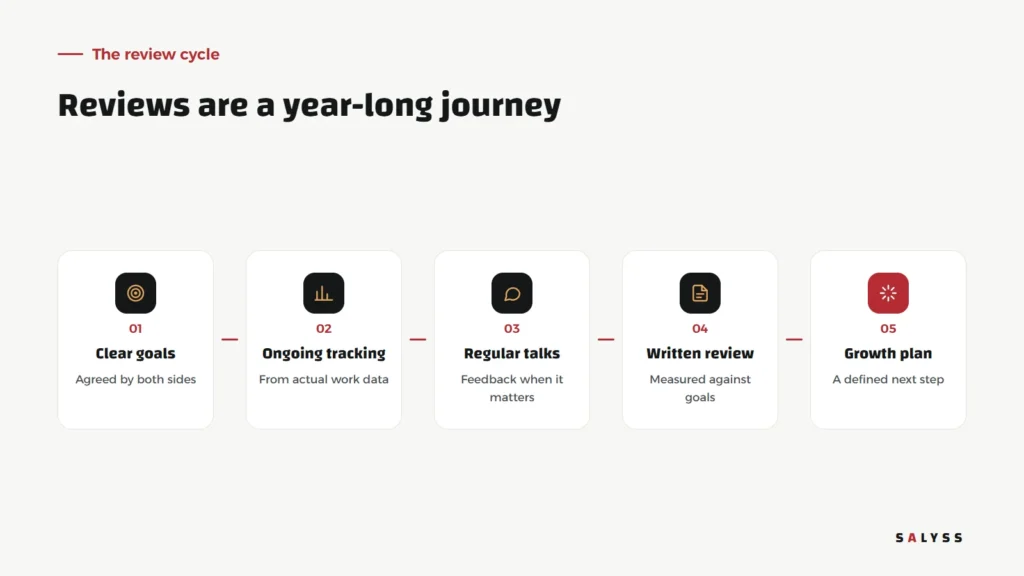
Clear goals agreed by both sides
At the start of the period, manager and employee agree what is expected: specific results and the behaviours that matter in the role. A salesperson knows what is expected in follow-up and closing; a collections officer knows the criteria they will be judged on. A goal the employee does not know cannot be held against them.
Tracking from real work data
When the team works on a system that records daily activity, much of the evidence is available without effort: follow-ups done on time, tasks completed, customers left without contact. This is not about reducing people to numbers; it means the conversation starts from shared facts. We covered suitable measures in sales KPIs worth tracking.
Regular conversations
A short meeting each month or quarter: what is going well, and what needs support? Feedback given on time corrects behaviour; feedback held back turns into reproach.
A written review
At the formal review, the manager compares performance with the agreed goals, using examples noted during the period rather than memory.
A growth plan
Every review ends with a next step: a skill to train, a new responsibility, or support the employee needs from management.
Impressions or evidence?
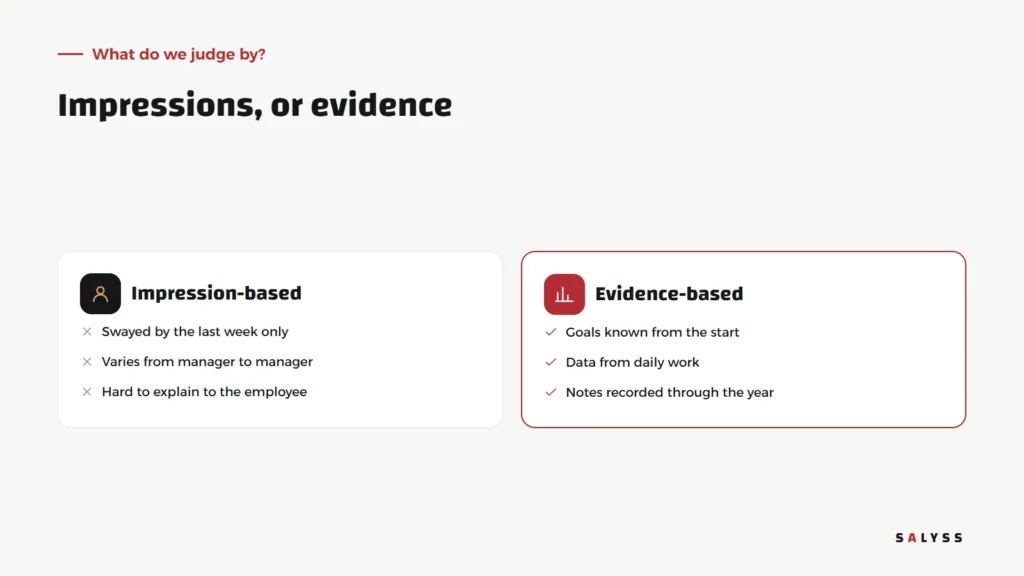
Impression-based reviews are not always ill-intentioned; they are the natural result of missing data. A busy manager cannot remember everything. So the most useful thing a company can do is make evidence available: written goals, recorded activity and noted observations. Then the review discussion is about facts and how to improve, not whether an impression is right.
The employee’s part
A good review is not made by the manager alone. An employee who notes achievements and difficulties through the period, and asks for feedback, arrives at the formal meeting prepared. A company can encourage this with a simple self-assessment form filled in before the meeting.
Fair does not mean identical
People in different roles are judged by different criteria, which is fairness, not discrimination. What matters is that people in the same role are judged by the same criteria and know them in advance. It also helps when management reviews different managers’ ratings side by side, to notice whether one tends to be stricter or more lenient than the rest.
Running the review conversation
The formal meeting is sensitive for both sides, and how it is run decides whether it motivates or discourages. Start by asking the employee how they see their own performance before giving yours; many people know their weak points and name them themselves. Discuss each goal with specific examples from the period, not general verdicts. When you raise a negative point, say what you expect instead, since criticism without an alternative leaves people unsure what to do. Close by agreeing two or three steps for the next period, written by both and revisited in the next regular conversation.
It also helps to give the employee a written summary afterwards, with a chance to comment. This does not weaken the manager; it builds the team’s trust that reviews are a fair process open to discussion, not a one-sided final verdict.
Mistakes to avoid
- Comparing an employee with a colleague instead of with their own goals.
- Judging personality instead of behaviour and results.
- Only criticism, or only compliments.
- Promising promotions or bonuses the manager cannot decide.
Where to start
Do not wait for the next review season. This month, pick one department, write three clear goals with each person for the coming months, and set a short monthly conversation. If the team works on scattered spreadsheets, consider moving daily work into a system that records it, as described in managing field teams without chasing them. To discuss a system that fits your company, explore SALYSS Platform (page in Arabic) or book a free consultation.
Frequently asked questions
How often should employee performance be reviewed?
The formal review may be twice a year or yearly, but conversations about performance should be regular and frequent, so nothing in the formal review comes as a surprise.
Should reviews be linked to bonuses?
The link helps when criteria are clear and known in advance. Tying rewards to a vague review damages trust more than it motivates.
How do I review roles that are not measured in numbers?
Define observable behaviours and results, such as punctuality, quality of delivery and cooperation, agree them with the employee upfront, and note examples through the year.