Cash flow management for growing companies
Companies that are profitable on paper still stumble because cash did not arrive on time. How do you track cash flow weekly and see a squeeze before it happens?

Many business owners find the problem late: sales are good, profits look reassuring on paper, yet the bank balance will not cover month-end payroll. The cause is usually not a loss but timing. Money the company has earned has not arrived yet, and obligations do not wait. Cash flow management means knowing when money comes in and when it goes out, before the gap between them catches you off guard.
Profit is one thing, cash is another
When you sell a unit in instalments or deliver goods on credit, the profit is booked, but the cash arrives in parts and later. Meanwhile payroll, rent and suppliers are paid on fixed dates. A company can be profitable and short of cash at the same time. The reverse holds too: a full account today does not mean a profitable business; it may be customer advances for work not yet done.
The cash cycle in your company
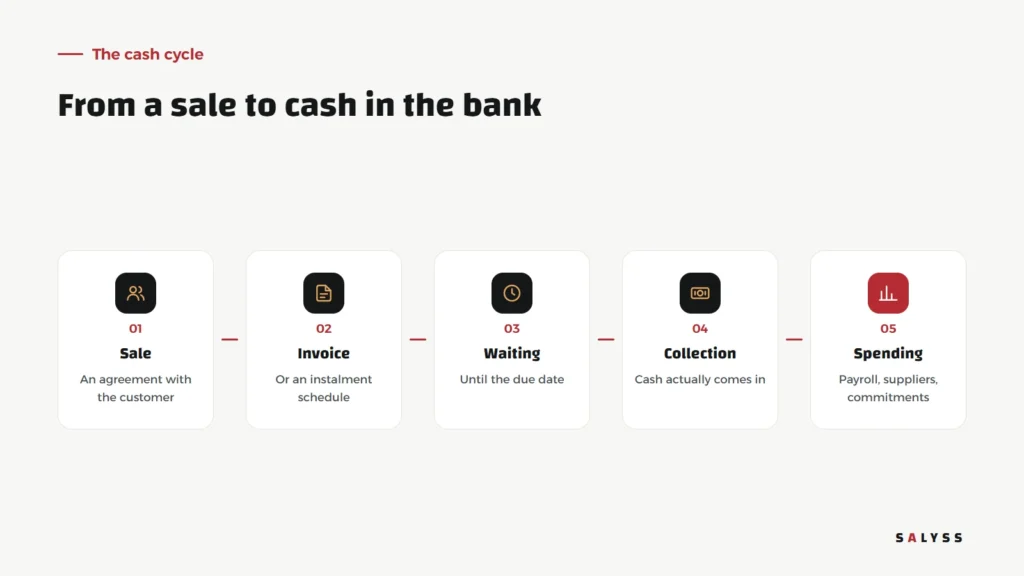
The cycle starts with an agreement, then an invoice or instalment schedule, then a wait until the due date, then actual collection, and finally spending on obligations. The longer the wait, or the weaker the collection, the more the company must fund the gap from elsewhere. Shortening this cycle, or at least knowing its length precisely, is one of the most valuable things financial management can do.
Where does cash leak?
- Collections without follow-up: instalments slip because nobody called before or right after the due date.
- Slow stock: goods bought but not sold, which is cash locked on shelves.
- Unbalanced payment terms: you pay suppliers in cash and sell to customers on credit.
- Mixed accounts: partner withdrawals from the company account without clear records.
- Small recurring expenses: unnoticed one by one, but adding up every month.
Forecast the next three months
The simplest cash tool is a sheet covering the coming weeks: what do you expect to receive each week, what is due, and what will the balance be at each week’s end? It does not need to be exact, but it must be honest. Estimate collections cautiously, since not every due instalment is paid on the day, and list obligations in full. If a week shows a negative balance, you know weeks in advance, which is enough time to act.
When sales and instalment schedules live in one system, much of this forecast is ready without manual entry, as we explained in connecting sales and accounting without re-entry.
Weekly habits that protect cash
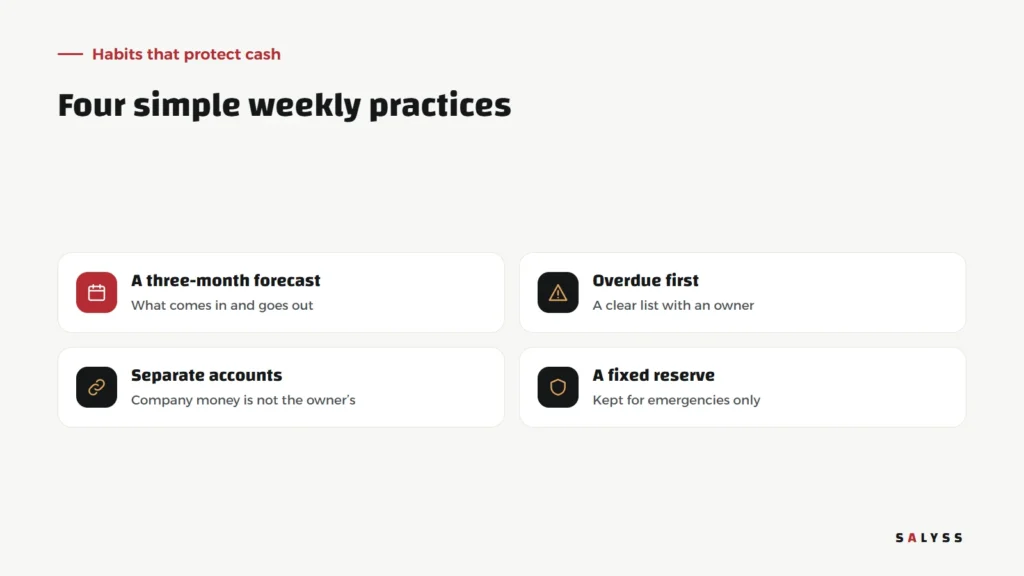
Overdue items first
A weekly list of everything past due, each with an owner and a next step. Gentle early collection is far easier than collection months later. We cover this in detail in collecting instalments without losing the customer.
Separate company and partner money
Every withdrawal is recorded with a name and a reason. This is not about distrust; it is about figures you can rely on.
A fixed reserve
An amount set according to monthly obligations and touched only in real emergencies. It buys you time to think instead of rushing decisions.
Review payment terms
Can you ask for a larger down payment, bring instalment dates closer, or negotiate longer terms with suppliers? Small changes in terms can reshape the whole cash picture.
What management should see every week
- The current balance across all accounts and cash boxes.
- What was collected this week against what was due.
- The overdue list and its oldest items.
- Large obligations over the next four weeks.
If gathering these figures takes a full day, the problem is the way of working, not the numbers. A dashboard calculated from daily work, like the one in a KPI dashboard for managers, cuts that to minutes.
When a cash squeeze is coming
If the forecast shows a hard week ahead, acting early opens options that vanish later. You can contact late payers before the big obligation falls due, negotiate a postponed payment with a supplier instead of apologizing on the day, or delay a non-urgent expense until the balance improves. Above all, be open with partners and management from the start; a last-day surprise leaves no time to think and forces decisions under pressure rather than after consideration.
Where to start
This week, build a simple three-month sheet: expected inflows, confirmed outflows and the balance at each week’s end. Then add the overdue list with an owner for each item. Within a month you will know exactly where cash leaks in your company. To have these figures ready from your system, explore SALYSS Realty (page in Arabic) for real estate companies, or book a free consultation.
Frequently asked questions
What is the difference between profit and cash flow?
Profit is recorded at the sale; cash flow is recorded when money actually comes in and goes out. A profitable company can fail to meet payroll if collections are late.
How often should cash flow be reviewed?
At least weekly for small and mid-sized companies, with a forecast covering the next three months, updated whenever something important changes.
Do I need a dedicated system to track cash?
Not necessarily at first, but when sales and collections live in one system connected to accounting, the figures become more accurate, faster and less dependent on manual gathering.