Customer retention: how to bring customers back
Winning a new customer takes time, effort and money, while losing an existing one usually happens in silence. How do you build a relationship that brings customers back and makes them recommend you?

Most companies spend nearly all their marketing effort on winning new customers: ads, offers, visits and calls. That makes sense; growth needs new customers. But at the other end of the business something quieter and more dangerous is happening: customers who bought once and never came back, with no complaint and no goodbye. Nobody notices they are gone, because nobody follows them after the sale. Customer retention is not a loyalty programme or a discount card. It is a way of working that starts the moment a customer pays, and it is the subject of this SALYSS Business Guide article.
Why do customers leave in silence?
Customers rarely leave because of one big incident. More often they leave because small ones pile up: a delivery that slipped without an apology, a question that waited days for an answer, a new employee who asked them to explain again what they had already explained, an offer that did not fit because nobody remembered what they bought. Each moment is small, but together they tell the customer they are just a name on a list. Then a competitor remembers their name and replies quickly, and they move without feeling they made a big decision.
In most companies the problem is not the team’s intentions but scattered information. What the customer bought sits in the accounting system, their complaint sits in a chat on one employee’s phone, and their renewal date sits in the memory of someone who has since left. You cannot keep a customer you cannot see in full.
From one sale to a relationship
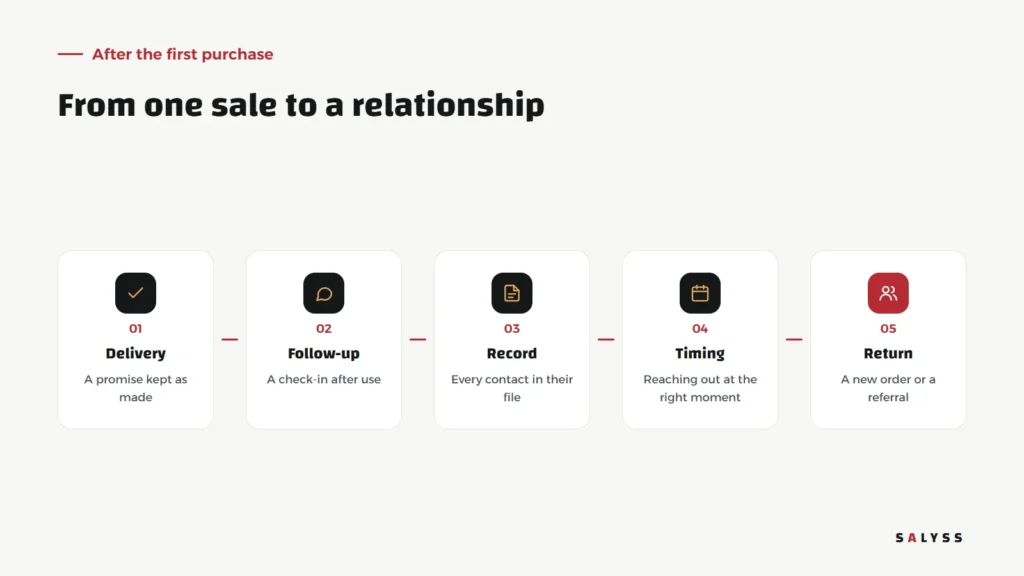
Deliver as promised
The first test of the relationship is whether the customer gets what was promised, when it was promised. If that is not possible, tell them before they find out. Being honest about a delay builds more trust than an on-time delivery with no contact at all.
Check in after use
A short call or message some time after the purchase: is everything as you expected? Do you need any help? That simple question surfaces problems while they are small and tells the customer you still care after they have paid. We covered this side in detail in after-sales service.
One record per customer
Every contact, order, complaint and note in the same customer file. When the customer calls, whoever answers knows what happened before without asking. That is what a CRM system really is: a shared memory for the whole company.
Reach out at the right time
Every business has a natural moment for customers to return: a contract renewal, a buying season, a service visit, an upcoming instalment. Once that moment is recorded in the system, it becomes a reminder for the employee instead of relying on memory.
Signs a customer is drifting away
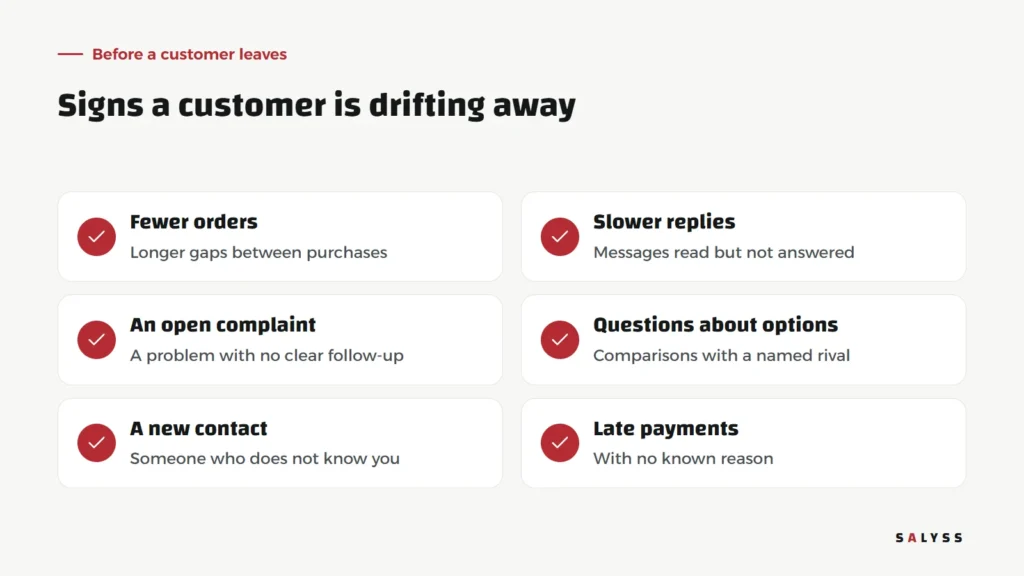
A customer who is thinking of leaving leaves traces first: they order less, reply later, ask about something you do not offer, or have a complaint that stays open. Sometimes your contact at the customer’s company changes, and someone new arrives who knows neither you nor your history together. Each of these signs deserves a call from someone with the authority to fix the problem, not an automated message. What matters is spotting them regularly, not discovering them by chance once the customer has already decided.
Common retention mistakes
- Relying on discounts alone: the customer comes back once, then waits for the next one.
- Bulk messages that treat a customer who bought yesterday the same as one who has been gone for months.
- Measuring new sales only, without looking at who did not come back.
- Leaving it all to sales, when delivery and support are what shape the experience.
There is a deeper mistake than all of these: treating long-standing customers as guaranteed. A customer who has worked with you for years deserves no less attention than a new one, because they are the most able to recommend you, and the most damaging if they leave and talk about why.
How do you measure it?
You do not need complex formulas to start. Ask every month: how many customers who bought before bought again? Which customers have we not heard from for longer than usual? Where did new referrals come from? A management dashboard answers these questions when customer data lives in one place, and it makes retention a target you follow just like sales.
Where to start
Pick ten customers today who bought from you and did not return, and call them yourself. Do not offer them anything; ask how their experience was. What you hear will tell you where to begin. If you want one customer record your whole team can see, explore SALYSS Platform (page in Arabic), or book a free consultation to map your customer’s journey after the sale together.
Frequently asked questions
Is customer retention the sales team’s job alone?
No. Sales starts the relationship, but delivery, support and accounts all shape whether a customer comes back. That is why everyone should see the same customer record.
Are discounts the best way to keep customers?
A discount may bring a customer back once, but it does not build a relationship. What brings them back is keeping your promise, remembering them and reaching out at the right time.
How do I know a customer is about to leave?
Watch for signs such as longer gaps between orders, slower replies, an unresolved complaint and questions about alternatives. They show up in the record before the customer says anything.