Lead follow-up: where opportunities get lost
Most opportunities are not lost because the customer said no, but because nobody followed up at the right time. Four points where opportunities leak, and a practical follow-up path that closes them.

When a company reviews its sales at the end of the month, it usually looks at the deals that closed. The more important story is somewhere else: the customers who got in touch and then disappeared. Most of them did not reject the offer. They simply did not hear back at the right time, so they went elsewhere.
The good news is that these opportunities are not lost at random. They leak from specific points that can be closed.
Four points where opportunities leak
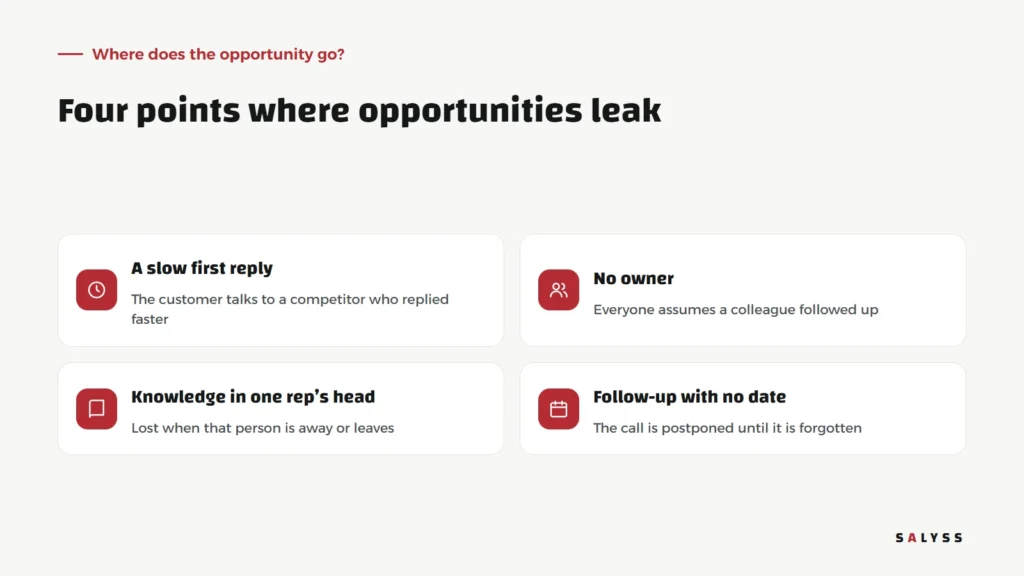
1. A slow first reply
A customer who fills in a form or sends a message is at a moment of interest, and they are rarely talking only to you. If your reply takes two days, a competitor may already have explained everything and booked a meeting.
2. No owner
The message lands on the company page or a shared number, and every employee assumes a colleague will answer. Everyone saw it. Nobody replied.
3. Knowledge in one rep’s head
A good rep remembers their customers, but memory is not a system. When they take leave or move on, colleagues lose the whole history: what the customer asked for, what price they heard, what they are hesitant about.
4. Follow-up with no date
“I’ll call them next week” is where many deals die. A follow-up without a set date keeps getting postponed until it is forgotten, and the customer goes cold.
A practical follow-up path
No single path fits every business, but the core idea holds: every step gives the customer something new and has a date and an owner. Here is an example you can adapt:
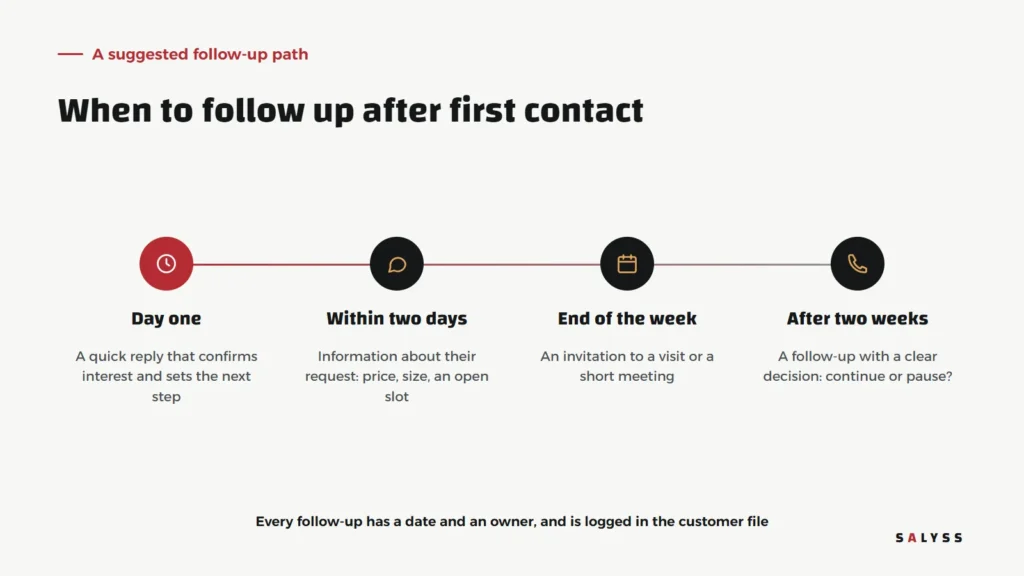
- Day one: a quick reply that shows you understood the request and sets the next step clearly.
- Within two days: information about their request, not a generic brochure: the price they asked about, the right size, an open slot.
- End of the week: an invitation to a visit or a short meeting, because meeting moves the conversation from enquiry to decision.
- After two weeks: a follow-up that asks for a clear decision: continue now, or pause until a set date?
Notice that the path ends with a decision. A customer who says “not now” is not a lost opportunity if a clear date to come back is recorded.
What should be written down?
For follow-up to work as a team rather than as individuals, every customer needs one file with at least:
- Where the customer came from: the website, an ad, a call or a referral.
- Who owns them now.
- The last contact and its result.
- The next follow-up date.
- What matters to them and what they hesitate about.
With this simple data, any colleague can pick up the conversation where it stopped, and the manager can see late opportunities before they are lost.
How do you know follow-up is working?
You do not need a complex report to know whether your team follows up properly. Three simple signals, checked every week, are enough:
- Same-day replies: how many new customers got a reply on the day they reached out? If that number drops, the problem is usually how requests are assigned, not the reps.
- Opportunities with no next date: every open opportunity should have a follow-up date. One without a date is on its way to being lost.
- Overdue follow-ups: dates that passed without contact show where the team needs support or a new split of work.
Reviewed regularly, these signals turn follow-up from individual effort into a habit the whole team keeps.
From a spreadsheet to a system
A spreadsheet is a reasonable start for a small team. But it does not remind anyone of their dates, it does not stop two reps from following the same customer, and it does not connect follow-up to what comes after: the contract and the collection. That is why sales teams at companies using SALYSS work from the SALYSS Business Park app: each rep has an agenda with their dates, each customer has a file with every contact, and the manager sees late opportunities in one place.
If you want to know where opportunities leak in your company, you can book a free consultation to review your current follow-up path with us.
Frequently asked questions
When is the best time to reply to a lead?
As soon as possible, ideally the same day. A customer asking for information is often talking to more than one company, and the fastest clear reply earns an early place.
How many times should I follow up before stopping?
There is no fixed number. What matters is that each follow-up brings the customer something new and has a set date, and that it ends with a clear decision instead of stopping for no reason.
Is an Excel sheet enough to organize follow-up?
It can be for a very small team. As reps and customers grow, a sheet struggles to show who is responsible and when the next date is, and that is when a system is needed.