Annual business planning with measurable goals
A twenty-page annual plan is forgotten by February; three clear goals followed every month change a company. How do you make a yearly plan that actually gets done?

At the start of every year, many management teams meet to make a plan. It comes out long and ambitious, full of goals and initiatives; then daily work takes over, and by mid-year nobody remembers what was written. Annual business planning does not need a long document, but a few clear goals, each with a measure, an owner and a regular review.
Why are plans forgotten?
- Too many goals: when everything is a priority, nothing is.
- Vague wording: “improve performance” tells nobody what to do tomorrow.
- No owner: a goal owned by “the department” is owned by nobody.
- No follow-up: the plan is reviewed at year-end, when it is too late.
From a yearly review to monthly follow-up
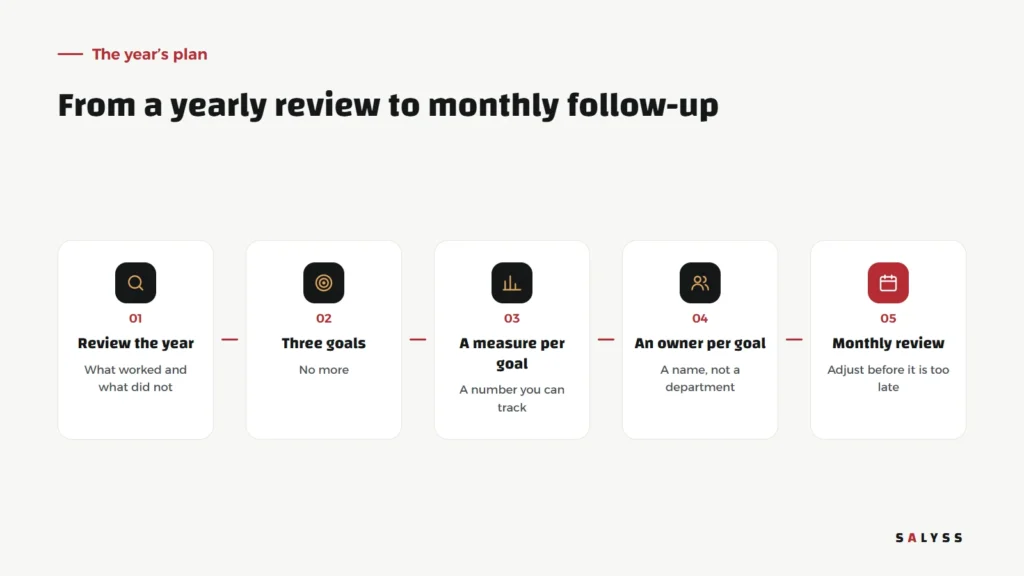
Review last year honestly
Before planning ahead, look at what happened: what worked? What did not? Why? Most importantly: what did we expect to work that did not? This review stops you repeating last year’s plan under a new title.
Choose three goals
No more. Three big goals everyone understands, where every employee knows how they contribute. If you cannot choose, ask: if only one goal were met this year, which would make the biggest difference?
A measure for each goal
A number you can track from actual data, not estimates. It must be available in your system without special effort, or it will not be followed.
An owner for each goal
A person’s name, not a department. That person does not do everything alone, but follows progress, reports on it and asks for help when needed.
A monthly review
A short meeting each month: where are we on each goal? What is holding us back? What do we change? This review is what keeps the plan alive.
A vague goal, or a measurable one
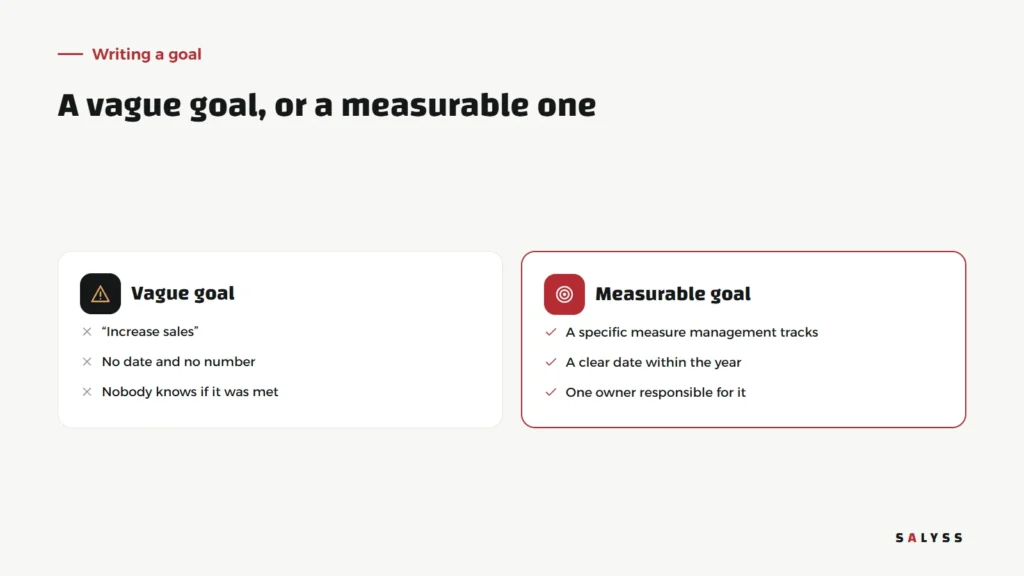
“Increase sales” is not a goal; it is a wish. A measurable goal sets a measure management tracks, a clear date and a single owner. It does not have to be a big number; it only has to be clear enough that everyone knows at year-end whether it was met. And it should be based on last year’s real figures, not a number that sounds good in the meeting.
Examples of goals that suit mid-sized companies
- No lead left without a defined next step.
- Fewer overdue instalments than last year.
- Moving customer follow-up from spreadsheets to one system before mid-year.
- Launching a website that brings real enquiries, not just visits.
Notice that each can be measured from real data if the company works on a system that records its work.
From the goal to this month’s plan
An annual goal is big by nature, so it needs a monthly translation. At the start of each month, ask each goal owner: what are the two most important steps this month? If the goal is fewer overdue instalments, the first month’s step might be organizing and assigning the late-payers list, and the second month’s step starting reminders before every due date. Small, clear steps make a big goal doable.
Systems make follow-up possible
The biggest obstacle to a monthly review is that gathering the numbers is exhausting. When management needs two days to assemble the month’s figures from spreadsheets, the review is postponed and then dropped. When the numbers are on a dashboard calculated from daily work, the review takes minutes, and the discussion is about decisions rather than whether the figures are right.
Start this month
Do not wait for the new year. Gather the management team for two hours: review what has passed, choose three goals for the coming months, set a measure and an owner for each, and agree the date of the first monthly review. Read about management dashboards, or book a free consultation.
Frequently asked questions
How many goals should an annual plan have?
Few, around three. Too many goals scatter effort, and a team cannot focus on ten things at once.
What is the difference between a goal and an activity?
A goal is a result you want to reach; an activity is what you do to get there. “Improve collections” is a goal; “a reminder call before every instalment” is an activity that serves it.
What if the market changes during the year?
That is what the monthly review is for. A good plan is adjusted when reality changes, instead of being abandoned or clung to regardless.