A business operating system, not just a website
A website presents your company, but the company itself runs behind it: sales, customers, collections and a team. When should those parts become one system, and where do you start?

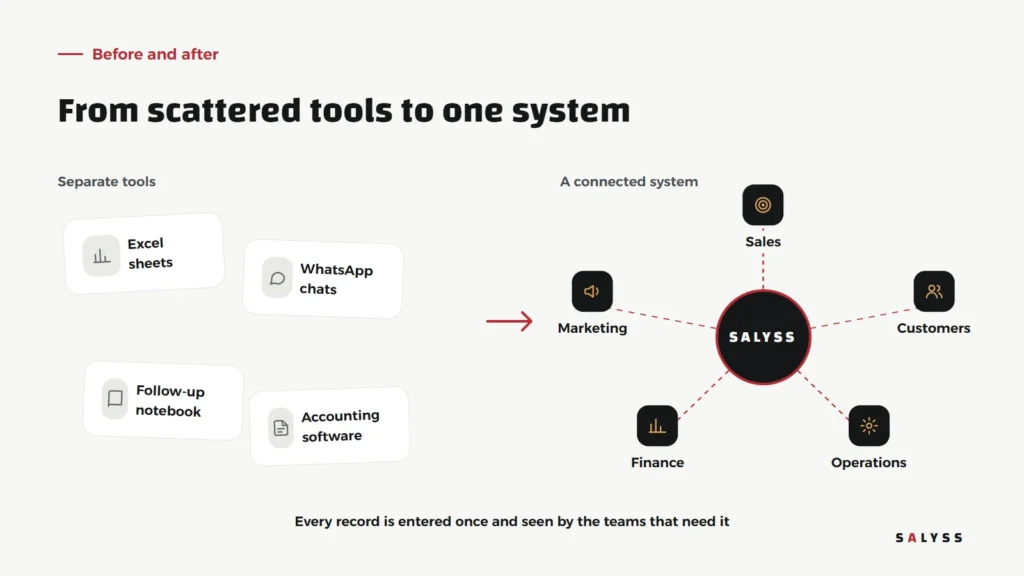
Ask any business owner a simple question: how many customers contacted you this month, and how many are still waiting for a reply? Most of the time the answer comes from three places: a spreadsheet on the sales manager’s laptop, chats on a sales rep’s phone, and a finance report that knows nothing about either. The answer exists. It is just scattered.
That is the difference between a company that has a website and a company that has an operating system.
The website is the front. The company works behind it
A good website introduces the company and receives requests. But its traditional role ends when the message arrives. Then a long journey begins that the visitor never sees: who contacts the customer, and when? What were they told? Was the unit reserved or the order shipped? Was the first payment made?
Each of those steps is usually handled in a different tool, by a different person. As the company grows, the number of tools and people grows, and so do the gaps between them.
Where does the problem show up?
It rarely shows up all at once. It shows up in small daily details:
- A customer calls twice because nobody replied, and the manager finds out a week later.
- A sales rep leaves and takes their customer list and chats with them.
- The sales figure in the management report does not match the collections figure in finance, and the team spends a full day reconciling.
- An important decision is made on a hunch because the numbers are not ready in time.
What do we mean by an operating system?
An operating system is not another app on top of your current tools. It is a way of connecting the parts of the company so they work as one body. It rests on four things:
Data entered once
The customer is recorded at first contact, and their file moves with every step: from follow-up to contract to collection. Nobody types the name and number again somewhere else.
Clear roles and permissions
Reps see their customers, the sales manager sees the team, and finance sees what concerns finance. Everyone knows what is expected of them, and responsibilities do not blur.
A workflow with dates
Every follow-up has a date and an owner, and every step has a status. When something is late, the delay shows instead of disappearing.
Reports from reality, not memory
Because the work itself happens inside the system, the numbers come straight from it. Nobody has to gather them from different places at the end of the month.
What does it look like in a real company?
At Mithaq Real Estate, one of the companies running on SALYSS, projects, units, customers and collections are managed from one system. The website presents the projects and receives customer requests. Requests go straight into the sales team’s follow-up. Contracts, instalments and receipts are linked to the Areeb accounting system, and the team works from the web and from a mobile app.

The value is not a nice screen. It is that the question we started with, how many customers are waiting for a reply, now has its answer in one place.
Where do you start?
You do not need a huge project that changes everything at once. The safest path has four steps:
- Map your current workflow as it really is, from first contact to receiving the money, not as it is supposed to be.
- Find the most painful point: do customers slip away before anyone replies? Are collections late? Do the numbers differ between departments?
- Start there and connect it to the website, so every new request goes straight into follow-up.
- Add the other parts in stages once the team is used to working from one place.
When don’t you need a full system?
Not every business needs a system from day one. If you run things yourself with a limited number of customers, simple and well-organized tools may be enough. The real need starts when there is a team, and when the company depends on more than one person knowing what is happening with the same customer.
If you recognize your company in the symptoms above, it is a good time to think about the next step. You can explore the SALYSS products or book a free consultation, where we map your current workflow with you and suggest where to start.
Frequently asked questions
Does an operating system replace accounting software?
No. It connects what happens before and after the accounting entry: the customer, the contract, the collection and the follow-up. It can be linked to your current accounting software instead of replacing it.
Is it suitable for small companies?
It suits any company with a team that deals with customers or orders every day. A business run by one person with a handful of customers may be fine with simple tools at first.
How long does it take?
It depends on the starting point. It is best to start with the part that has the most impact, such as customer follow-up or collections, and add the rest in stages.