Choosing business software: questions to ask first
Most stalled system projects did not fail in the code, but in questions nobody asked before signing. Six questions that protect you before you choose.
Choosing a software system is one of the most consequential decisions a company makes, and sometimes one of the least examined. Management sees a polished presentation, a reasonable price and a near delivery date, and signs. Months later the questions that should have been asked appear: who owns the data? What if we need a change? Who trains the team? Here are the questions our work has taught us make the difference, even if our own answers to them become part of your evaluation.
Six questions before signing
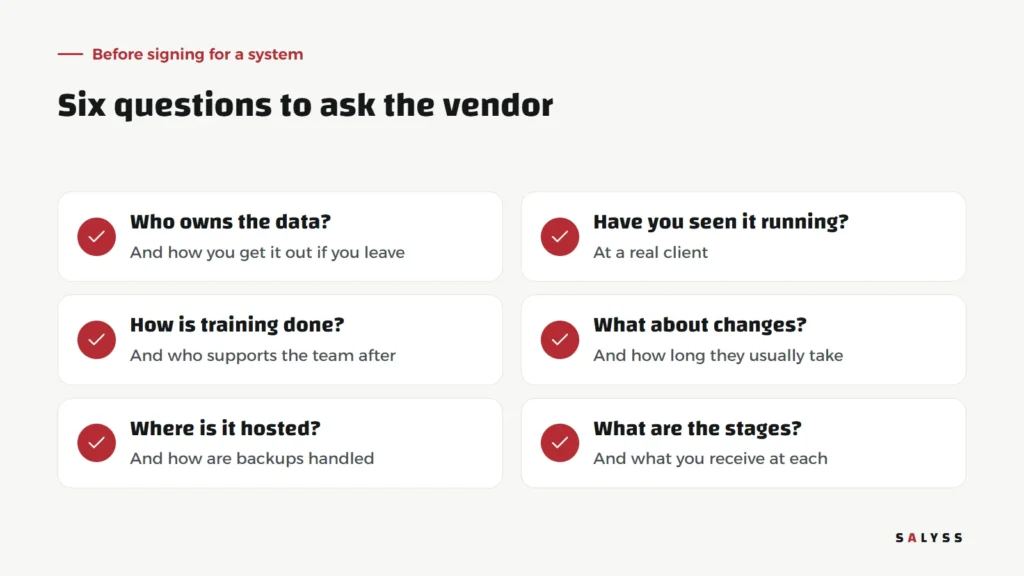
Who owns the data?
Your customer, sales and instalment data is the most important part of the system. Ask: can you export it all at any time? In what format? What happens to it if you end the contract? A vague answer here is a warning sign.
Have you seen it actually running?
A presentation shows the best picture. Ask to see a system running at a real client, and if possible talk to someone who uses it daily. That tells you what no demo can.
How is training done?
An excellent system the team does not use is worthless. Ask about the training approach, its length, and who supports the team after delivery when problems come up.
What about changes?
Your company will change, and the system must change with it. How are changes requested? How long do they usually take? How are they priced?
Where is it hosted?
How are backups taken, and how often? Who can access the server?
What are the stages?
What do you receive at each stage, and when can you start using part of it? A project that delivers nothing usable until the end is a big risk.
Off the shelf or built for you?
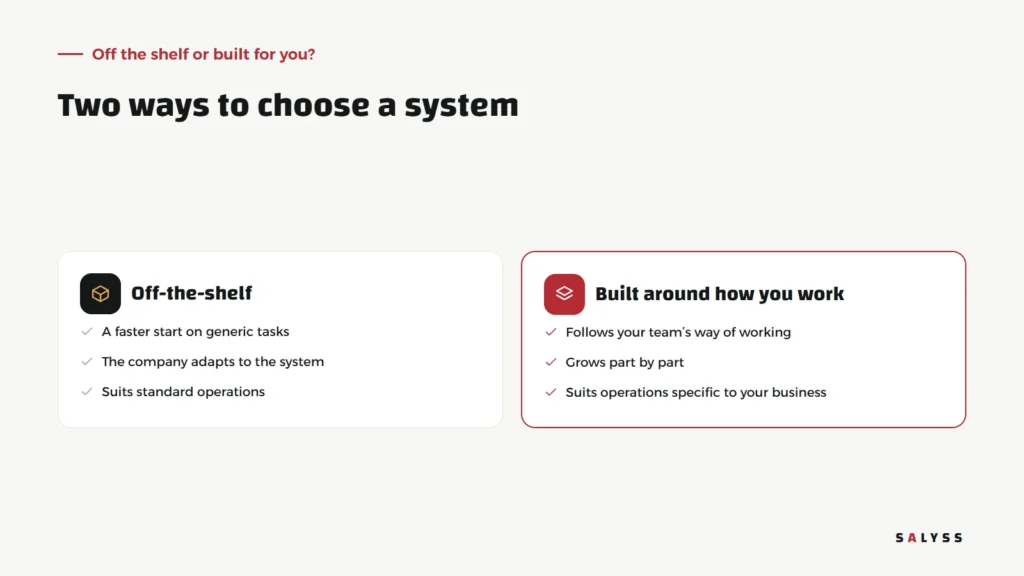
There is no single answer. Off-the-shelf systems start faster and suit standard operations such as general accounting or email, but they ask the company to adapt to them. A system built around how you work follows your team’s process, grows part by part, and suits operations specific to your business, such as instalment follow-up in a real estate company or the order journey in a store with cash on delivery. Many companies combine both: an off-the-shelf accounting system, and an operating system built for them and connected to it.
Warning signs
- A promise to deliver everything very quickly without a detailed understanding of your business.
- Not being allowed to see a system running at another client.
- Vague answers about data ownership and export.
- Nobody asks how your team works before quoting a price.
- Every small change after delivery is treated as a new project.
What we have learned from the other side
As a company that builds systems, we have learned that the most successful projects start by understanding the work before writing a line of code: who does what, where time is lost, what decisions management needs. We have learned that delivering in stages, so the team uses a real part early, reveals what needs changing before it becomes expensive. And that a system does not end at delivery; the companies we work with ask for additions whenever their team finds a new need.
Prepare before any meeting
- Write down the three main problems you want the system to solve.
- Identify who will use it daily, and ask them to attend the demo.
- Gather samples of the sheets and files the team works with today.
- Decide who makes the decision and who follows delivery on your side.
To see how we work, explore SALYSS Platform (page in Arabic), or book a free consultation and ask us these same six questions.
Frequently asked questions
What is the most important question before signing?
Who owns the data and how you can get it out if you decide to change. Data is the most valuable thing you hold in any system.
Is a custom system always better?
No. For standard operations an off-the-shelf system may be enough. A system built around how you work helps most when your operations are specific to your business.
How do I check the vendor’s experience?
Ask to see a system running at a real client, not just a presentation, and ask how support works after delivery.