Family businesses: from people to systems
A family business draws strength from trust and closeness, and its weakness is that everything runs through particular people. How do you move to systems without losing its spirit?

Most family businesses start with a founder who knows everything: every customer, every supplier, every number. That knowledge is the secret of their early success; decisions are fast, trust is high, and customers deal with the owner directly. But as the company grows and children and employees join, the secret becomes an obstacle. Every decision waits for one person, every piece of information sits in their memory or notebook, and any absence stops the work. Moving from management by people to management by systems is the real challenge for family businesses, and it is what we cover here from our work with companies that started this way.
How do you know the company needs systems?
There is no single moment, but the signs look alike in most companies:
- The owner cannot take a holiday without the team calling every day.
- A simple question such as “how much did we collect this month?” takes a day of calls and spreadsheets.
- Each family member gives staff different instructions, so they do not know which to follow.
- Disagreements between partners start with figures they do not agree on, not with differences of opinion.
- Good employees leave because they do not know the limits of their role or how they are judged.
If you recognize three of these, the problem is not the people; the company has outgrown the way it is run.
Run by people, or by systems?
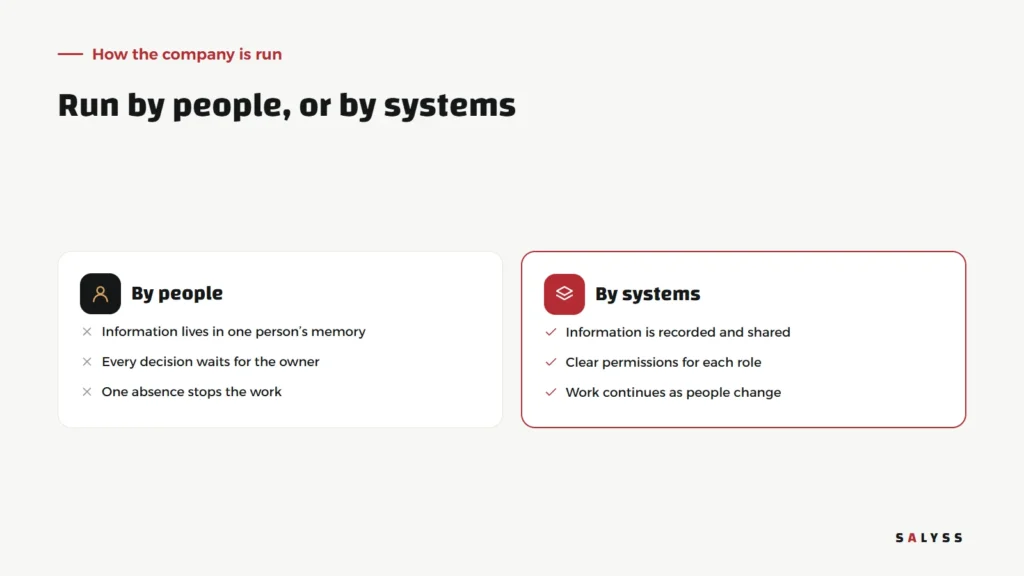
Running a company through people is not a mistake at the start; it is the natural way for a small business. The trouble is that it does not scale. When information lives in one person’s head, the whole company is limited by their time and energy. Running by systems means information is recorded in one place, each role has clear permissions, and work continues if someone is away or leaves. This does not remove the founder’s role; it frees them from daily detail to focus on decisions nobody else can make.
Lesson one: document experience before moving it
The biggest mistake in digitizing a family business is starting from the software instead of the people. The founder’s experience in pricing, in handling late payers, in choosing suppliers, is the most valuable thing the company owns. Sit with them and with long-serving staff, and write down the rules they apply without ever writing them: when is a discount given? Who approves it? How is a late customer followed up? These rules are what the system will be built on, and involving the founding generation in writing them turns expected resistance into ownership of the change.
Lesson two: clear permissions protect relationships
In a family business, personal relationships overlap with work, and clear permissions protect both. When everyone knows what they can see and decide, awkward situations shrink: an employee unsure whether to follow the son’s request or the father’s instruction, or a partner who feels information is being kept from them. The system does not impose authority; it makes agreements written and applied. We explained how to build role-based permissions in user permissions and customer data protection.
Lesson three: one number everyone agrees on
Many family disputes at work start with numbers. Each side has a spreadsheet, and the spreadsheets do not match. When sales, collections and expenses are recorded in one system from daily work, every figure has a single source everyone sees. The meeting moves from “where did you get that number?” to “what do we do about it?”. That alone changes the nature of partners’ meetings.
Steps to move without a shock
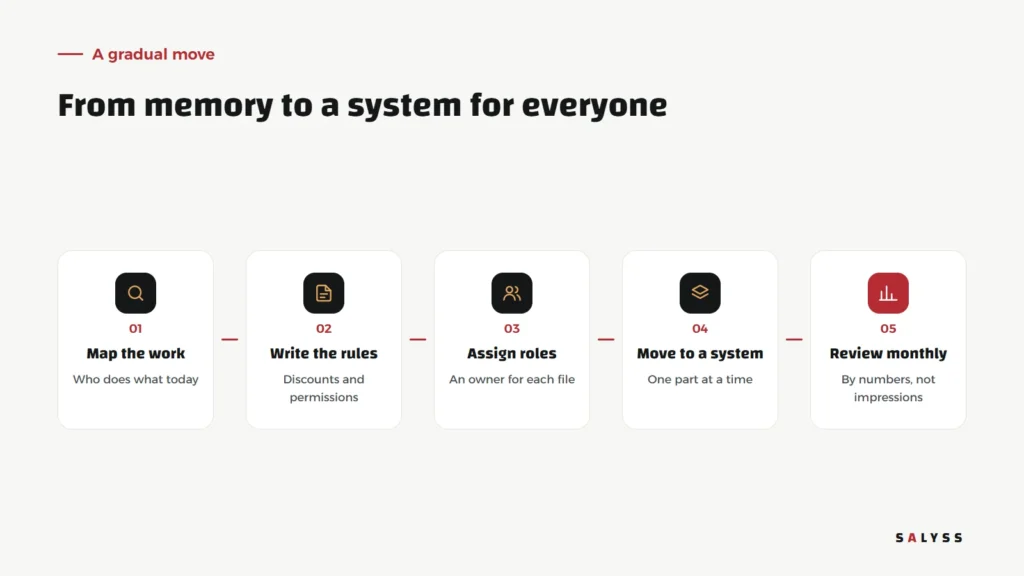
Map the work as it is today
Before any change, find out who actually does what, not what the organization chart assumes.
Write down the rules
Discounts, approval limits and how late payers are handled, written and agreed.
Assign roles
Each file has one named owner, whether family or not.
Move to a system one part at a time
Start with the most painful process, such as customer follow-up or collections, and add others once the team is used to it.
Review monthly
A monthly meeting with figures from the system, not impressions.
What have we learned?
Working with companies that started as family businesses, we have learned that a successful system resembles the company’s way of working rather than forcing a foreign one on it. That is why we build an operating system around how the team really works, starting with the part it needs most. We have also learned that the second generation often leads the change, but its success depends on respecting what the first generation built.
Employees from outside the family
One of the hardest positions in a family business belongs to the capable employee from outside the family. They see decisions made in family gatherings they do not attend, and they do not know how far they can go. Clear systems give them what they need: a written role, known permissions, and an evaluation based on their recorded work rather than closeness to anyone. That is what lets the company attract and keep talent, instead of depending on family members alone however large it grows.
Where to start
Ask yourself: if you were away for two weeks, which process would stop first? That is your starting point. Explore SALYSS Platform (page in Arabic), or book a free consultation to map your company’s first step together.
Frequently asked questions
Do systems mean we do not trust family members?
No. A system protects trust, because it makes information clear to everyone and prevents the misunderstandings that happen when figures live in one person’s memory.
Where should a family business start?
With the process that stops most when a particular person is away, such as approving discounts or following up collections. Start there, then move on.
How do we handle objections from the founding generation?
By involving them in mapping how work is done before it moves into a system. Their experience is what must be documented; the system preserves it rather than replacing it.