CRM systems: managing customer relationships
A CRM is not a list of names and numbers; it is the company’s memory of every customer: who contacted them, what was said, and what happens next. When do you need one, and how do you start without your team rejecting it?

In many companies, customer information is spread across employees’ phones, WhatsApp chats and Excel sheets, each salesperson with their own copy. That works while the team is small and stable. Then someone leaves, and the history of dozens of customers leaves with them. A CRM, a customer relationship management system, exists to solve exactly this: making the company’s knowledge of its customers belong to the company, not to individuals.
What does a CRM actually do?
The idea is simpler than the acronym suggests. Each customer has one file holding their details, where they came from, every contact made with them, who made it, and the next step with its date. When that date approaches, the system reminds the responsible employee. When management wants to know what is going on, it opens one board instead of asking everyone.
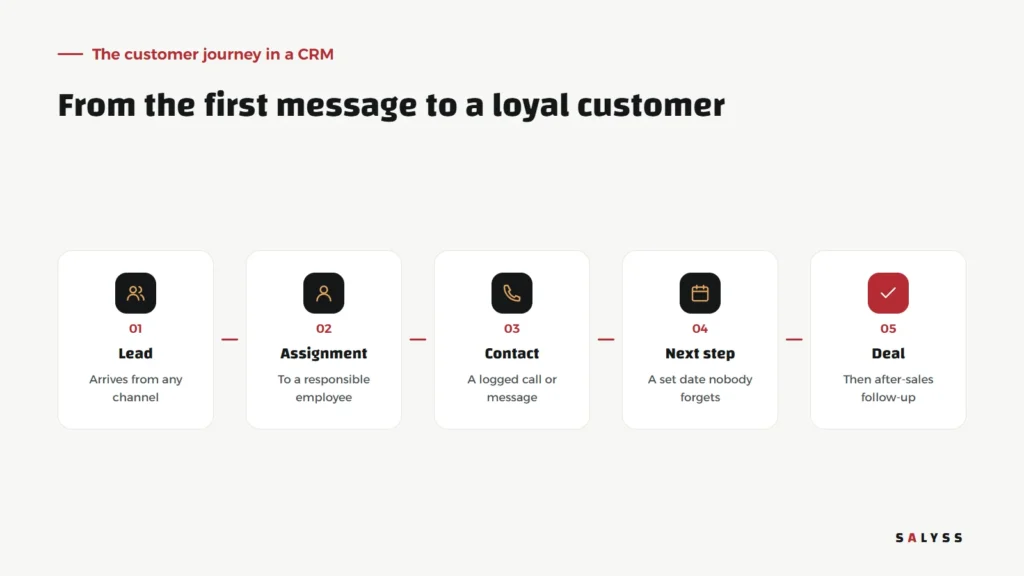
The lead
It arrives from an ad, the website, a call or a referral. The first value of the system is recording the source, so you later know which channel brings real customers rather than just numbers.
Assignment
Every lead is assigned to a responsible employee by a clear rule, so two people never call the same person, and nobody is left unattended.
Contact and the next step
After each call or visit, the employee records what happened and sets a dated next step. This simple habit is the heart of the system: a customer with no next step is a customer on the way to being forgotten.
Sheets and chats, or one system
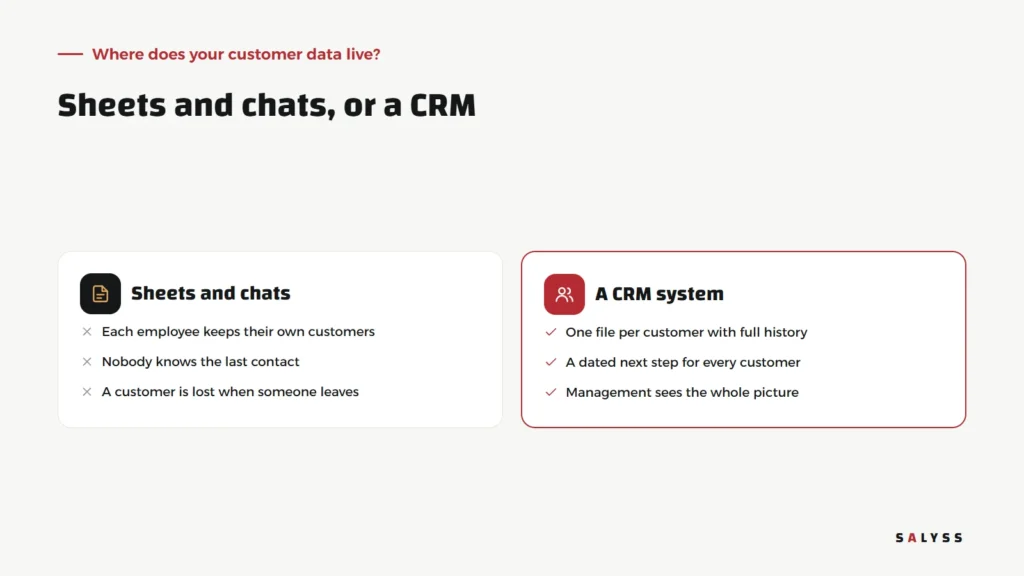
Spreadsheets are not bad, but they remind nobody of anything, do not know who changed what, and do not stop the same customer being contacted twice. The more customers and staff you have, the wider the gap between the sheet and reality. We cover that gap in detail in our article on lead follow-up.
When does your company need a CRM?
- When you cannot quickly answer: how many leads do we have right now, and who owns them?
- When a customer complains that nobody called, or that several people did.
- When a salesperson leaves and you realize you know nothing about their customers.
- When you spend on ads without knowing which campaign produced actual deals.
- When the weekly sales report takes a full day to put together.
What to look for when choosing
Easy mobile entry
Salespeople are in the field or on the phone. If logging a call means opening a laptop, nothing will be logged. A mobile app or interface is a requirement, not a luxury.
Fit with how you work
Sales stages in a real estate company differ from an online store or a services firm. A good system lets you name your own stages instead of imposing generic ones.
Connection to the rest of the business
A CRM gets stronger when it connects to the phone system, so calls appear in the customer file, and to accounting, so a deal becomes an invoice without re-entry. Read about connecting sales and accounting.
Permissions
Not every employee needs to see every customer. Clear permissions protect customer data and stop it walking out with whoever leaves.
Why some CRM projects fail
Most stalled projects do not fail because of the software but because of how it was introduced. A system imposed without training, one that demands fields nobody uses, or management that keeps following up through chats instead: all reliable ways to turn a CRM into a burden. The rule we have learned: if management does not open the system every day, the team will not either.
What should management see?
A CRM’s value for management lies not in how many customers are recorded, but in the questions it answers quickly. How many leads arrived this week, and from which channel? How many were actually contacted? Which customers have no next step? Where do deals usually stall: after the first call, after the visit, or at the offer? When these answers sit on one board, the sales meeting moves from asking each person for news to discussing what needs to change, and campaigns are judged by real deals rather than by the number of incoming messages.
How we apply it at SALYSS
Customer follow-up is central to SALYSS products. In SALYSS Realty (page in Arabic), the customer is linked to the unit, the offer and the instalments; in SALYSS Connect (page in Arabic), communication channels come together in one place. The aim is the same in both: no customer without an owner, and no owner without a next step.
Where to start
- Gather your current customers from every sheet into one list and remove duplicates.
- Define your company’s real sales stages, in names your team understands.
- Agree one rule: no customer without a next step and a date.
- Start with a small team for two weeks, then roll out what worked.
If you would like us to review how you follow up with customers today, book a free consultation.
Frequently asked questions
How is a CRM different from a customer spreadsheet?
A spreadsheet stores customer data; a CRM stores the history of the relationship: every contact, who made it, and the next step with its date, and it reminds the team.
Is a CRM right for small companies?
Yes, if it starts simple. A company with three salespeople also loses customers when it relies on memory and scattered messages.
How do I get the sales team to use it?
Make it easier than the alternative: quick entry from mobile, reminders that help the employee, and management that follows up from the system rather than from chats.