Digital transformation for SMEs
Digital transformation is not a giant project that changes everything overnight. It is a series of small steps, starting with the problem that costs your company most today.

The phrase “digital transformation” scares many owners of small and mid-sized companies. They picture a huge project, a big budget, consultants, and months of disruption before anything works. So many postpone the decision and stay with the old way until it costs more than changing would.
In reality, digital transformation for SMEs looks completely different when you see it as a series of small steps, each with a clear result.
What people assume, and what actually happens
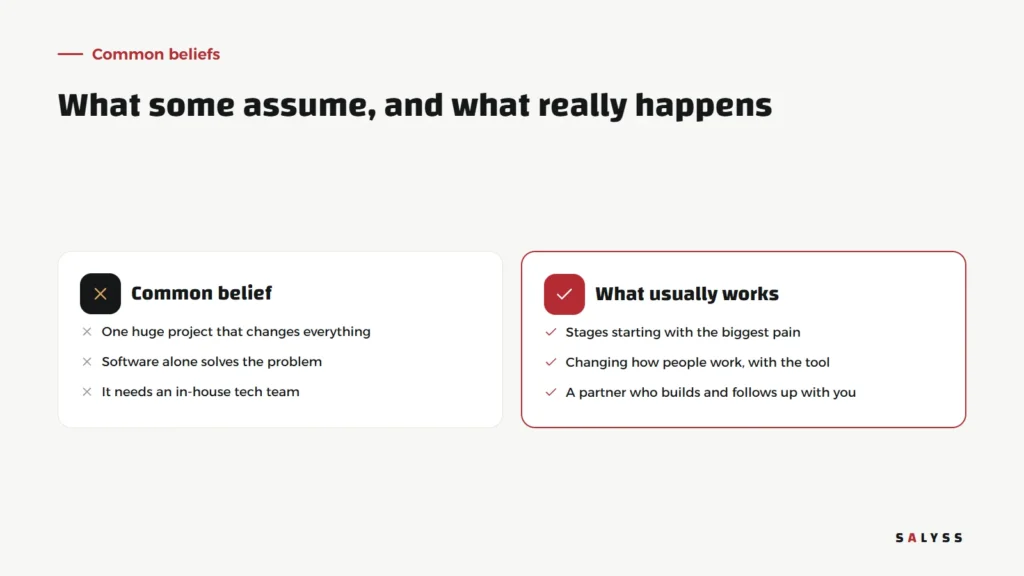
Belief one: it is a project that changes everything at once. What usually works is the opposite: stages that start with the company’s most painful point, then move on to the next.
Belief two: software alone solves the problem. Software is a tool; if the way of working stays the same, the software gets used in the same old way. Real change happens when the way of working changes with the tool.
Belief three: you need an in-house tech team. Many companies succeed with a partner who builds and follows up, while understanding of the business and its decisions stays with the owners.
Five small steps with clear results
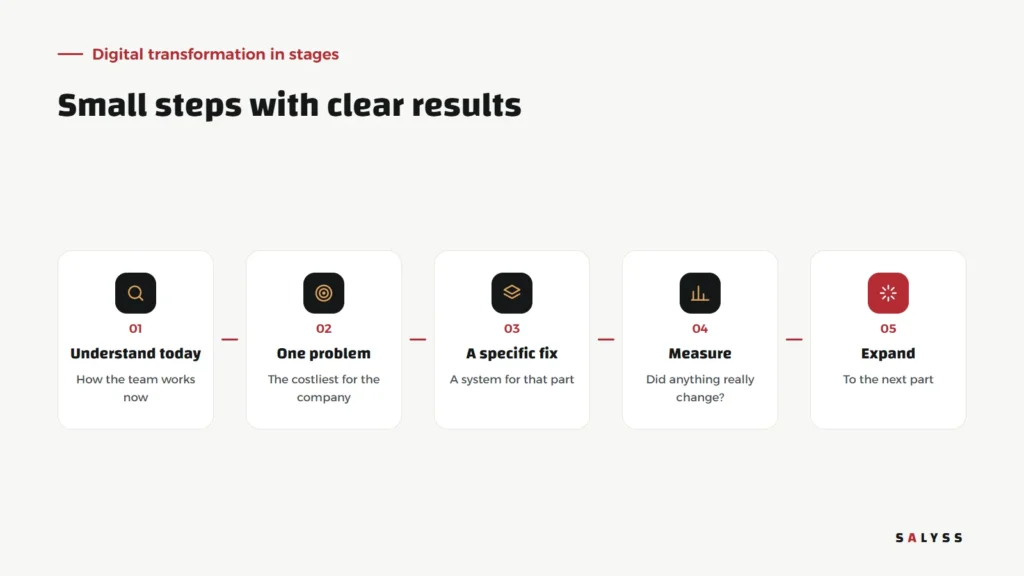
1. Understand today
Before any tool, watch how the team works now. Where is information recorded? Who waits for whom? Where does time go? Sit with the people who actually do the work, not just the managers; they know best where the problem is.
2. Pick one problem
From everything you found, choose the problem that costs the company most: leads lost without follow-up, late collections, forgotten orders. Just one.
3. Apply a focused fix
A system for the chosen part, used daily by the team concerned. Not a system for everything, but one that solves this problem well.
4. Measure
Decide before you start what you will measure: report preparation time, the number of customers nobody called, or the number of late orders. Then compare after a while. If nothing changed, the problem is in the rollout, not the idea, and it needs a review before expanding.
5. Expand
Once the team sees a real result, moving on to the next part is much easier. The first success is the best argument for the second step.
Signs your company is ready for the first step
- You know which problem costs you most, even if you do not know the fix yet.
- Someone in the company has the time and authority to follow the rollout with the team.
- Management is willing to use the new system itself, not just ask the team to.
- The team complains about the current way of working, which is a good sign: they know it does not work.
If these are in place, there is no need to wait for “the right time”. A small first step today beats a big plan that never starts.
Management’s role
Any transformation fails if it stays one department’s project. Management must decide clearly that the new system is the reference, and use it themselves; if a manager asks for the report from the old sheet, the team will conclude the new system is optional. Management also has to accept a short transition in which work is a little slower before it gets faster.
Where do companies usually start?
In our experience, most companies start in one of three places: lead follow-up, collections and payments, or orders and stock. These touch money directly, and results show quickly. You can read about each in the SALYSS Business Guide.
SALYSS products are built for this approach: start with one part and add others as you need them. Explore SALYSS products and tools, or book a free consultation to define your company’s first step together.
Frequently asked questions
Is digital transformation suitable for small companies?
Yes, and it can be easier there: decisions are faster and teams are smaller. What matters is starting with a specific problem, not a sweeping plan.
Do we need an in-house tech team?
Not necessarily. You can work with a partner who builds the system and follows up with your team, while understanding of the business and its decisions stays in-house.
How do we know it worked?
Set a clear measure before you start, such as report preparation time or the number of customers left without follow-up, then compare after rollout.