Gulf expansion: are your systems ready?
Before opening a branch or selling into a Gulf market, ask a question few people ask: are your systems ready to work in two languages, several currencies and different rules?

Many Egyptian and Arab companies see the Gulf market as their next growth step. Preparation usually focuses on clear questions: a local partner, licensing, an office, marketing. But one question tends to come late, once its problems show: are your internal systems ready?
Expanding into the Gulf market with systems built for a single market means the new team starts with workarounds: separate sheets, manual currency conversion, reports pulled from two places. And workarounds tend to stay.
What needs to be ready?
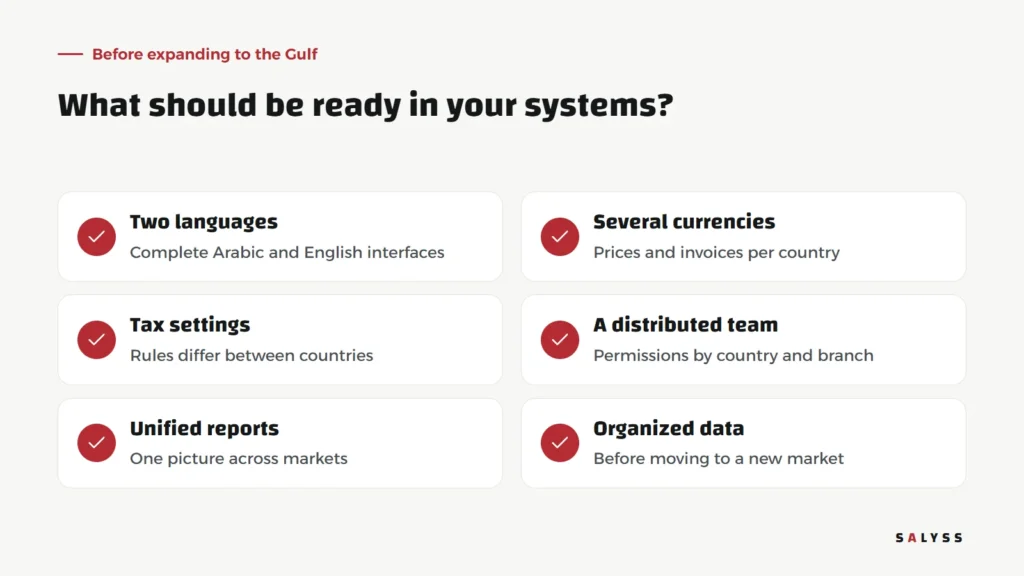
Two complete languages
Customers and staff in the Gulf work in Arabic and English together. The website and internal system need complete interfaces in both languages, including messages, invoices and reports, not just a translated home page.
Several currencies
Prices and invoices must show in each country’s currency, with clarity on how they convert when reports are combined. A common mistake is recording amounts in different currencies in the same field without distinction, which makes any total meaningless.
Tax settings
Tax rules and procedures differ between countries and sometimes change. The system should let you configure them per country without code changes, and the decisions themselves should be made with a tax specialist in each market.
A distributed team with clear permissions
The new country’s team needs to see its own customers and orders, not all company data. Permissions by country and branch protect data and keep screens clear.
Unified reports
Management needs one picture of all markets, with the option to view each on its own. If each country runs on a separate system, manual reporting comes back.
Organized data before the move
If your data in your first market is disorganized, expansion will double the mess. Put the house in order first.
From your first market to the new one
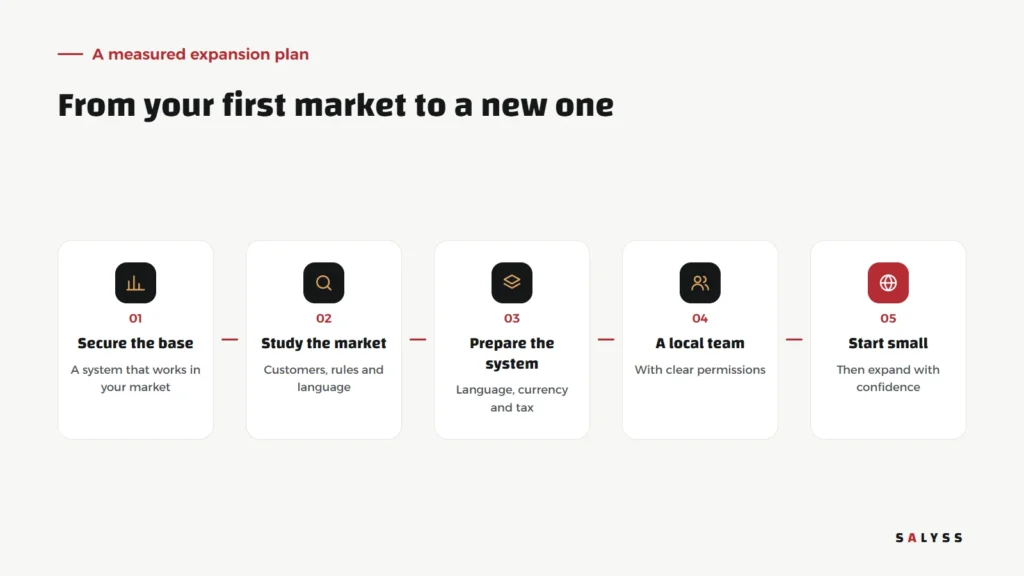
- Secure the base: a system that works well in your current market, which the team really uses and whose numbers it trusts.
- Study the market: customers and their expectations, rules and procedures, and the language of business.
- Prepare the system: language, currency and tax, before the new team starts.
- A local team: with clear permissions from day one, trained on the same system your core team uses.
- Start small: one product, service or city, then expand with confidence once everything works.
Common expansion mistakes
- Copying the site and machine-translating it: Gulf customers notice weak translation immediately, and the company loses their trust before it starts.
- Leaving the new team without a system: “we will add them later” usually means the team builds its own way in spreadsheets, which is hard to merge afterwards.
- Forcing everything to be identical: some differences between markets are real, such as preferred payment methods and working hours. A good system unifies the base and allows the necessary differences.
- Neglecting bilingual customer service: a bilingual website loses its value if customers cannot find someone to answer them in their language.
Why one system is usually better
A separate system per country can look simpler at first, but it means duplicated customer data, reports merged by hand, and every update applied twice. One system that supports several markets keeps the picture connected and makes it easy to carry what you learn in one market to another.
On SALYSS Platform we build systems that work in more than one language and currency, with permissions by branch. If you are planning to enter a Gulf market, book a free consultation to review your systems’ readiness before you move.
Frequently asked questions
Is an English website enough?
Usually not. Customers in the Gulf use both Arabic and English, so you need complete interfaces in both languages, not partial translations.
Do tax rules differ between Gulf countries?
Yes, rules and procedures differ between countries. Tax settings in your system should be configurable per country, with advice from a specialist in each market.
Do we need a separate system for each country?
Not necessarily. One system that supports several markets, with permissions by country and branch and reports that combine the full picture, is usually better.